Category
Manufacturer
Model
Boucherie
Boucherie is synonymous with brush manufacturing machinery, offering specialized systems for producing diverse brush types used in consumer goods and industrial applications. Their equipment includes automated machines that ensure high precision and efficiency in the production processes. Boucherie has been a pivotal figure in advancing brush manufacturing technology, enabling the creation of quality products on a large scale.
FAQ:
What is Boucherie brush tufting technology and how does it work?
Boucherie tufting is a brush manufacturing method where filament bundles are folded in half and mechanically anchored into pre-drilled holes in a brush base or block. The folded filament creates a loop at the anchor point, which locks the tuft in place without the use of staples, adhesives, or wire. This mechanical anchoring produces a significantly stronger tuft hold than staple-set methods, which is why Boucherie-made brushes tend to outlast and outperform their staple-set counterparts in demanding applications.
The process begins with a drilling or molding stage that creates precisely positioned holes in the brush blank, followed by the tufting stage where the machine inserts and anchors the folded filaments at high speed. On fully automated systems, both stages can be integrated into a single production line, with CNC controls managing hole patterns, tuft density, and filament trim lengths. This level of precision makes Boucherie machinery well suited for applications where consistency across large production runs is critical, such as toothbrushes, paintbrushes, and industrial cleaning brushes.
What types of brushes can be produced using Boucherie machinery?
Boucherie machinery is used across a wide range of brush categories, both consumer and industrial. Common products include toothbrushes, paintbrushes, brooms, scrub brushes, cosmetic brushes, and a broad range of industrial cleaning and surface treatment brushes. The method is particularly popular for products where tuft retention and bristle density matter, since the anchor-loop design resists shedding even under heavy mechanical stress or repeated washing.
Industries that rely on Boucherie-method production include painting and decorating, personal care and cosmetics, food processing, janitorial supply, and general industrial maintenance. The machinery can handle a wide variety of brush base materials, including wood, plastic, and composite blocks, and is compatible with both natural bristle materials such as hog hair and boar bristle, as well as synthetic filaments like nylon, polyester, and polypropylene. This versatility makes Boucherie equipment a practical investment for manufacturers serving multiple market segments from a single production platform.
What filament and bristle materials are compatible with Boucherie tufting machines?
Boucherie tufting machines are designed to handle a broad spectrum of filament materials, which is one of the reasons the technology has remained relevant across so many brush manufacturing sectors. Synthetic filaments are the most common input material and include nylon (various diameters and profiles), polyester, polypropylene, and mixed-blend filaments engineered for specific performance characteristics such as chemical resistance or abrasion tolerance. Natural bristle materials, including hog hair, boar bristle, and horsehair, are also compatible with many Boucherie tufting systems, particularly those configured for paintbrush or cosmetic brush production.
Filament diameter, stiffness, and cut length all influence machine settings, so operators typically need to adjust feed mechanisms, anchor depth, and trim parameters when switching between material types. Machines with CNC or programmable controls make these changeovers considerably faster than older mechanically fixed models. Buyers sourcing used Boucherie machinery should confirm which filament types and diameters the specific machine was configured for, and whether the tooling on hand supports the materials they intend to run.
What production speeds can be expected from a Boucherie brush manufacturing machine?
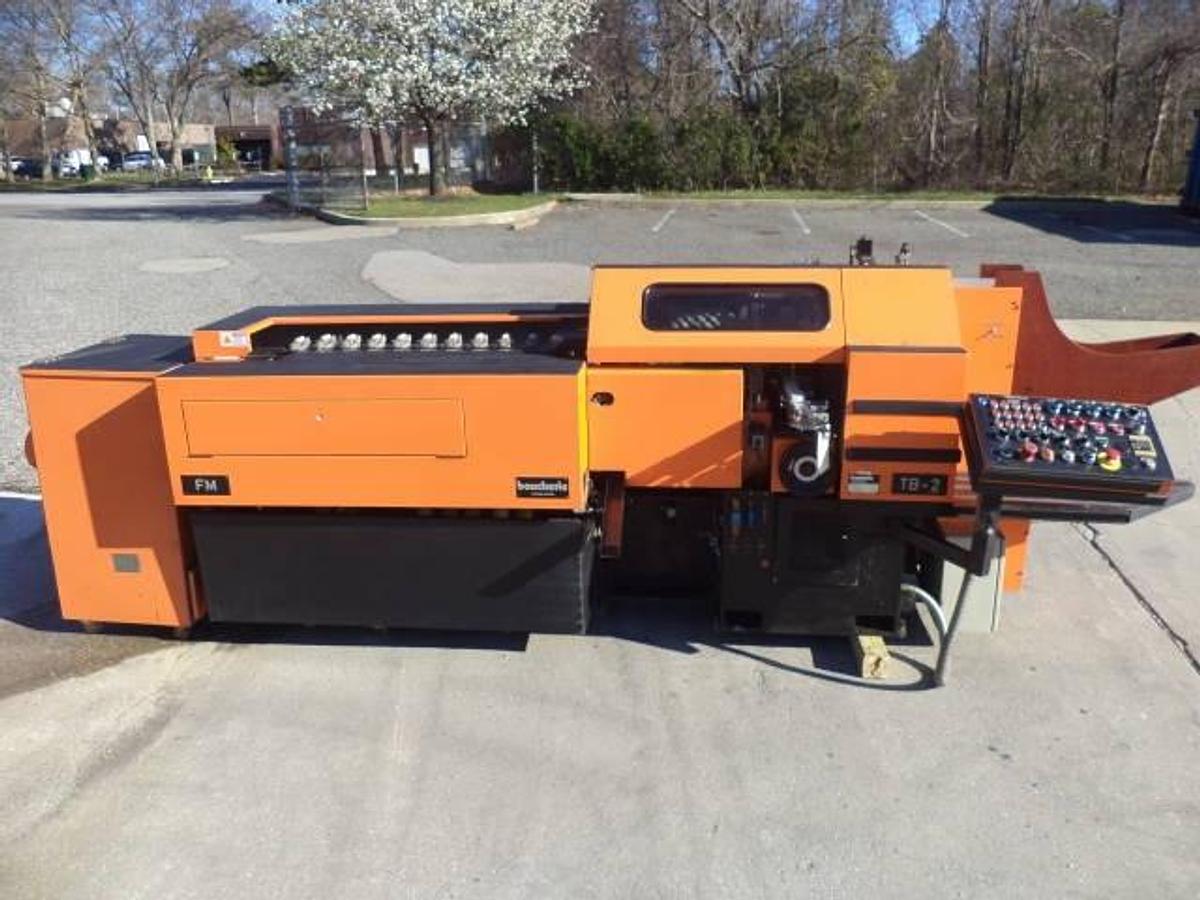
Production speeds vary considerably depending on the model, configuration, and level of automation. Entry-level semi-automatic Boucherie machines may produce a few hundred tufts per minute and require more manual intervention between cycles, making them better suited to small-batch or specialty production. At the higher end, fully automated industrial systems can reach speeds of 750 tufts per minute or more, as seen on machines like the Boucherie TB2 combined with an FM assembly module, which is designed for high-volume toothbrush manufacturing.
Actual throughput in brushes per hour depends on the number of tufts per brush, the complexity of the hole pattern, and cycle time for loading and unloading brush blanks. A machine running 750 tufts per minute on a toothbrush with 25 tufts per head, for example, could theoretically process around 1,800 toothbrush heads per hour under optimal conditions. Buyers should ask for the specific model's rated output and, where possible, review production records or arrange an inspection to observe the machine running, since real-world throughput on used equipment can differ from manufacturer specifications depending on the machine's condition and current configuration.
What is the typical price range for used Boucherie brush manufacturing machines?
Pricing for used Boucherie machinery varies widely based on model, age, configuration, and overall condition. Simple semi-automatic tufting benches can be found at the lower end of the market for a few thousand dollars, while mid-range automated systems with integrated drilling and tufting capabilities typically sell in the range of $20,000 to $80,000 or more. High-output, fully automated CNC-controlled lines, including multi-station assembly systems for toothbrush or paintbrush production, can command prices well into six figures depending on their specifications and how recently they were last in production service.
Buyers should factor in more than just the purchase price. Freight, rigging, and crating costs can add meaningfully to the total landed cost, particularly for heavier or multi-component systems. Spare parts availability and the cost of any tooling or changeover components specific to the buyer's intended brush type should also be considered. Consulting with a dealer who specializes in brush manufacturing equipment is the most reliable way to get an accurate valuation for a specific machine, since general industrial machinery pricing guides rarely account for the niche nature of brush manufacturing equipment.
Are used Boucherie machines a reliable choice for brush production?
Used Boucherie machines have a strong reputation for durability, and many units remain in productive service for decades with proper maintenance. The mechanical simplicity of the core tufting mechanism, combined with the quality of construction typical of Boucherie equipment, means that well-maintained machines can perform reliably long after their initial installation. Buyers in the brush manufacturing industry regularly source used Boucherie equipment as a cost-effective way to expand capacity or replace aging machines without the lead times associated with ordering purpose-built equipment.
That said, the reliability of any specific used machine depends heavily on how it was maintained and operated in its previous service life. Buyers should approach the purchase carefully: request a thorough inspection, either in person or via detailed video, and ask about the machine's maintenance history and the reason for its sale. It is also worth contacting Boucherie or their authorized service network directly to understand what level of technical support, spare parts availability, and documentation can realistically be expected for the specific model and vintage being considered, since older machines may have limited parts support.
What should buyers look for when inspecting a used Boucherie machine before purchase?
A thorough inspection of a used Boucherie machine should cover both mechanical condition and the completeness of the machine as configured. Key areas to examine include the condition of the tufting anchors and feed mechanisms, wear on the drilling spindles if the machine includes an integrated drilling station, the state of the drive system and any servo or CNC controls, and the overall condition of the frame and guarding. Any signs of improvised repairs, missing safety components, or heavy wear on high-cycle parts deserve close attention, as these can indicate deferred maintenance.
Buyers should also verify that the machine includes all tooling, change parts, and documentation that were part of the original setup, since specialty tooling for specific brush types can be expensive or difficult to source separately. Inspections are typically offered by reputable dealers either in person or through detailed video walkthroughs. Some machines may still be installed at the facility where they were last used, which can allow for a live demonstration under power. Keep in mind that most equipment dealers are not set up to run full production trials, so the inspection will generally focus on mechanical operation rather than finished product output.
What are the power and utility requirements for installing a Boucherie brush machine?
Power requirements for Boucherie brush manufacturing machines depend on the size and complexity of the system. Smaller semi-automatic machines may operate on single-phase power in the range of 110V to 220V and require minimal compressed air, making them relatively straightforward to install in a standard workshop environment. Larger automated systems typically require three-phase power, commonly at 380V to 480V depending on the country of manufacture and configuration, along with a stable compressed air supply for pneumatic actuators and clamping mechanisms.
Buyers should request the full electrical and utility specifications for any machine they are considering before finalizing a purchase, since retrofitting a facility to meet unexpected power or air requirements adds cost and time to the commissioning process. Machines originally manufactured for European markets, which is common with Boucherie equipment given the company's Belgian origins, are often wired for 50Hz three-phase power and may require transformer or drive modifications for use in North American facilities running at 60Hz. Discussing these requirements with an electrician or a machinery installation specialist before the machine ships will help avoid delays during setup.
How does shipping and delivery typically work for used Boucherie machinery?
Shipping used brush manufacturing machinery involves more logistical planning than standard freight, particularly for larger multi-station systems. The machine will typically need to be properly prepared for transit, which may involve draining any fluids, securing moving components, and either palletizing or crating the equipment depending on its size and fragility. Crating provides better protection but adds to the overall freight cost. Buyers should ask the selling dealer for a clear breakdown of what preparation is included in the purchase price and what will be charged separately, since these costs can vary significantly.
Larger machines often require specialized rigging equipment for loading and unloading, including forklifts with appropriate capacity or overhead crane access, and this rigging work is generally an additional cost beyond standard freight. For international shipments, buyers also need to account for customs clearance, import duties, and any local compliance requirements. Getting a complete landed cost estimate, covering the machine price, crating, freight, rigging at both ends, and any import fees, before committing to a purchase is the most reliable way to avoid budget surprises. Most reputable dealers can assist in coordinating freight logistics or provide referrals to experienced machinery shippers.
What payment terms are typical when purchasing used brush manufacturing equipment?
The standard practice in the used industrial machinery market is for dealers to require full payment prior to shipping the equipment. This applies to most transactions regardless of machine size or purchase price, and it reflects the practical reality that once a machine ships, the dealer has limited recourse if a buyer disputes the purchase after the fact. Payment is typically accepted by wire transfer, and buyers should confirm accepted payment methods with the dealer early in the process to avoid delays.
Some dealers may extend payment terms to established customers with a prior purchase history, but this is the exception rather than the rule for first-time buyers. Buyers financing a machinery purchase through a third-party lender or equipment finance company should have their financing confirmed and in place before making an offer, since most dealers will not hold equipment for extended periods without a deposit or confirmed payment timeline. Asking about deposit requirements and the timeline between payment and shipping is a reasonable part of any pre-purchase conversation with a dealer.