Category
Manufacturer
Model
Biner Ellison
Biner Ellison is a leading provider of manufacturing equipment for packaging and bottling industries, focusing on providing automated and semi-automated solutions. They are well-known for producing high-quality filling machines, labeling systems, and capping machines tailored to the needs of food and beverage manufacturers. Their equipment is designed to enhance production efficiency and ensure consistent product quality, making them a trusted partner for companies looking to streamline their packaging processes.
FAQ:
What types of filling machines did Biner Ellison manufacture?
Biner Ellison built a range of liquid filling machines designed to handle different product viscosities and container formats. Their lineup included piston fillers, overflow fillers, and gravity fillers, each suited to specific applications. Piston fillers are typically used for thicker, more viscous products like sauces, creams, and gels, while overflow fillers work well for thin, free-flowing liquids where a consistent fill level in the container is important for appearance. Gravity fillers handle low-viscosity liquids like water, juices, and light oils with minimal mechanical complexity.
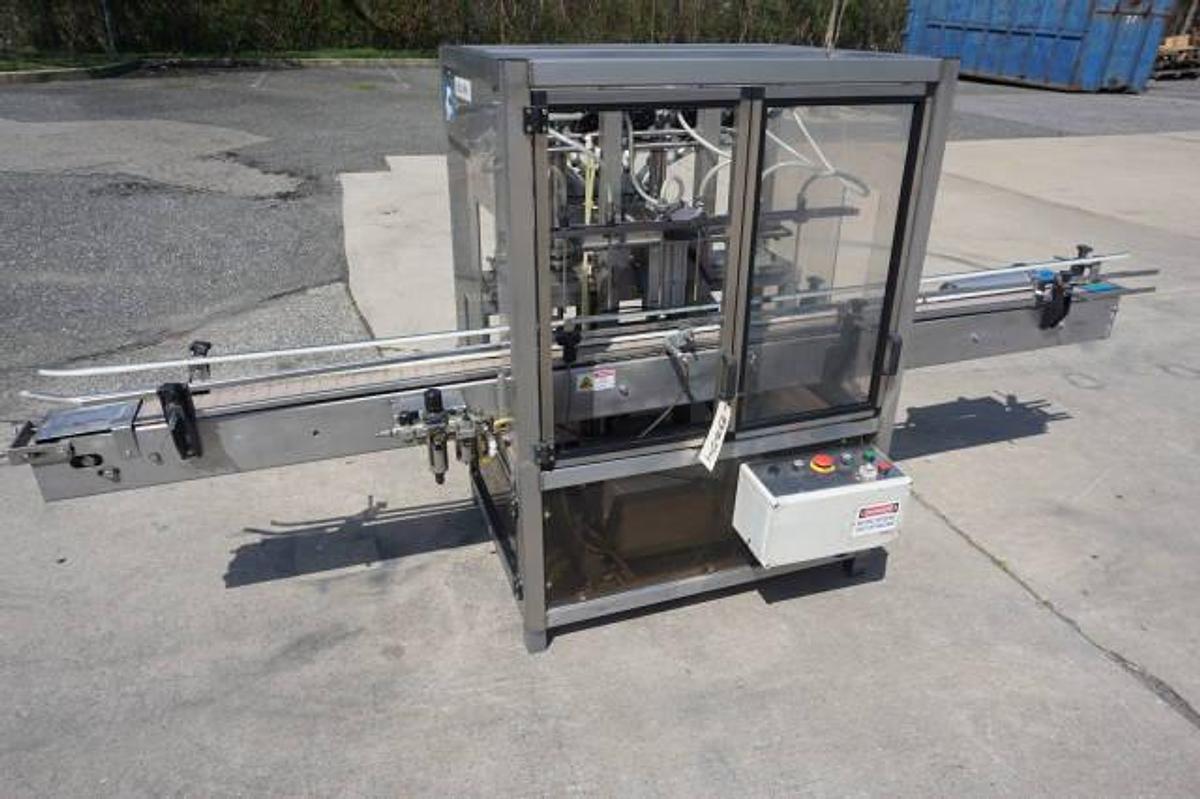
Beyond filling machines, Biner Ellison also produced labeling systems and capping machines, making their equipment a common choice for companies that wanted to build out a more complete packaging line. Their machines were built with an emphasis on durability and consistent fill accuracy, which is a big reason why used Biner Ellison equipment continues to be sought after on the secondary market long after the company stopped manufacturing. Buyers looking at used units will most commonly come across straight-line piston fillers, including multi-head configurations designed for higher-volume production environments.
What industries commonly used Biner Ellison filling machines?
Biner Ellison filling machines found wide adoption across several industries, most notably food and beverage, pharmaceutical, and cosmetics manufacturing. In the food and beverage sector, their equipment was used to fill products ranging from sauces, dressings, and condiments to juices and other beverages. The pharmaceutical and nutraceutical industries relied on their machines for accurate, repeatable fills of liquid medications, supplements, and health products, where dosing precision is critical. Cosmetic and personal care manufacturers used Biner Ellison equipment for products like lotions, shampoos, and liquid soaps.
The broad cross-industry appeal of their machines came down to the flexibility of their designs. A piston filler, for example, can be adjusted to handle products with very different viscosities simply by changing fill settings or tooling, making the equipment useful across multiple product lines within a single facility. This versatility, combined with the machines' reputation for solid construction, is why used Biner Ellison filling machines continue to attract buyers from a wide range of manufacturing backgrounds. Companies evaluating a used unit should consider whether the machine's configuration and materials of construction are appropriate for their specific product type.
What fill volume ranges do Biner Ellison filling machines typically support?
Fill volume capabilities on Biner Ellison machines vary depending on the model and configuration, but their equipment was generally designed to cover a practical range of container sizes common in food, beverage, pharmaceutical, and personal care packaging. Many of their piston filler models can be adjusted to fill volumes from as little as a few milliliters up to several liters per cycle, making them adaptable for everything from small unit-dose containers to larger bulk retail packaging. The specific range for any given machine depends on the cylinder size installed and whether the machine has been set up with interchangeable components.
When evaluating a used Biner Ellison filling machine, buyers should ask the seller for the machine's documented fill range and confirm whether any additional cylinders or tooling are included with the sale. Some used machines come with multiple cylinder sizes that expand the usable fill range, which adds significant value. It is also worth consulting with the manufacturer or a qualified technician to understand whether the machine can be reconfigured for fill volumes outside its current setup, since parts availability for older Biner Ellison models can vary depending on the age and specific model in question.
What is the typical production speed of a Biner Ellison filling machine?
Production output on Biner Ellison filling machines depends on several factors, including the number of fill heads, the fill volume per cycle, the viscosity of the product being filled, and the level of automation on the specific model. Multi-head straight-line piston fillers, like the six-head configurations that appear on the used market, can fill multiple containers simultaneously per cycle, which significantly increases throughput compared to single-head machines. In general, well-maintained piston fillers in this class can achieve output rates ranging from several hundred to over a thousand containers per hour under the right conditions.
For used machines, actual production speed may differ from the machine's rated capacity depending on its current mechanical condition, the fill volume being run, and how well it has been maintained over its service life. Buyers should ask sellers about the machine's last known production environment and, where possible, request a video demonstration or in-person inspection to observe the machine cycling. Keep in mind that most used equipment dealers do not have the permitting or facility setup to run actual product through a machine during an inspection, so cycle speed demonstrations are typically done dry or with water as a substitute fluid.
Are parts and technical support still available for older Biner Ellison filling machines?
Because Biner Ellison is no longer an active manufacturer, parts availability depends largely on what is still in circulation through aftermarket suppliers, machine shops capable of fabricating replacement components, and occasionally other used machines being parted out. Common wear items like seals, gaskets, nozzles, and cylinders for piston fillers are often available through third-party suppliers who specialize in filling machine components, since many of these parts are based on standard industrial specifications. More model-specific components may be harder to source and could require custom fabrication.
Before purchasing a used Biner Ellison machine, it is worth contacting the manufacturer or any remaining authorized service networks to understand what level of support is realistically available for the specific model and age of machine you are considering. Some older models may have limited documentation or parts support, while others that were produced in larger quantities may have better aftermarket availability. Buyers should also ask the seller whether the machine comes with any documentation such as operator manuals, maintenance records, or parts lists, as these can be invaluable for keeping the machine running and sourcing replacement components down the road.
How do I choose the right Biner Ellison filling machine model for my production needs?
Selecting the right filling machine starts with a clear understanding of your product's physical characteristics and your production requirements. The most important factors to evaluate are product viscosity, fill volume range, container type, and the throughput you need to achieve. For thin, free-flowing liquids, an overflow or gravity filler is often the most practical choice. For thicker products like sauces, creams, or gels, a piston filler is generally better suited because it uses a positive displacement mechanism that handles viscous materials more reliably. The number of fill heads on the machine directly affects how many containers can be filled per cycle, so matching head count to your production volume targets is an important part of the selection process.
For used Biner Ellison machines specifically, buyers should also factor in the machine's current condition, its configuration relative to their product requirements, and the availability of parts for that particular model. A machine that is well-suited on paper but requires hard-to-find components may end up being a costly choice in the long run. Requesting an inspection, either in person or via video, is a practical way to assess mechanical condition before committing to a purchase. If possible, consult with a packaging engineer or an experienced used equipment dealer who specializes in filling and packaging machinery to help match the right machine to your specific application.
What should I look for when inspecting a used Biner Ellison filling machine before buying?
A thorough inspection of a used filling machine should cover both mechanical condition and documentation. On the mechanical side, look at the overall condition of the frame, fill heads, nozzles, cylinders, and any conveyor or indexing components. Check for signs of corrosion, worn seals, damaged pneumatic or electrical components, and any evidence of improvised repairs. For piston fillers specifically, the condition of the pistons and cylinders is critical since these are the core components that determine fill accuracy and consistency. Ask whether the machine has been recently serviced and whether any components have been replaced.
Used equipment dealers will typically accommodate in-person inspections or provide video walkthroughs of machines for remote buyers. Some machines may still be installed in an active production facility, which can allow you to see the equipment in an operational environment, though keep in mind that most dealers cannot run actual product through a machine during an inspection due to facility and permitting limitations. Along with the physical inspection, ask the seller for any available documentation including operator manuals, maintenance logs, and a parts list. Machines that come with complete documentation are generally easier to maintain and operate, and the presence of good records is often a sign that the equipment was well cared for during its service life.
What is the typical price range for used Biner Ellison filling machines?
Pricing for used Biner Ellison filling machines varies considerably based on the model, number of fill heads, overall condition, and what accessories or documentation are included with the machine. Entry-level single or dual-head configurations in average condition can be found at lower price points, while larger multi-head straight-line piston fillers in good working condition command higher prices, sometimes reaching into the tens of thousands of dollars depending on the configuration and the seller. Because Biner Ellison is no longer manufacturing equipment, the secondary market price is also influenced by scarcity, particularly for popular models that are harder to find.
Buyers should factor in more than just the purchase price when calculating the total cost of acquiring a used filling machine. Shipping, rigging, any required refurbishment or parts replacement, and installation costs can add meaningfully to the final landed cost. Requesting a detailed quote from the seller that breaks out packaging, crating, and freight charges before committing to a purchase is a smart way to avoid surprises. Comparing prices across multiple reputable used equipment dealers who specialize in packaging and filling machinery is also a good way to get a realistic sense of market value for the specific model you are considering.
What should buyers know about shipping a used Biner Ellison filling machine?
Filling machines require careful preparation before shipping to prevent damage in transit. Depending on the size and weight of the machine, this can involve palletizing, crating, or more substantial custom packaging to protect sensitive components like fill heads, nozzles, and pneumatic assemblies. Larger multi-head straight-line fillers are heavy pieces of equipment that may require professional rigging for both loading at the seller's facility and unloading at the buyer's location. Rigging costs are typically separate from freight charges and should be clarified upfront.
Buyers should ask the seller for a detailed breakdown of all costs associated with getting the machine to their facility, including packaging, rigging, freight, and any applicable fees for liftgate service or inside delivery. Freight rates will vary based on the machine's dimensions and weight, the origin and destination, and the shipping method used. Understanding the full landed cost before finalizing a purchase is important, since shipping a large piece of industrial equipment can represent a meaningful portion of the total investment. Most used equipment dealers require full payment prior to shipping, so having all cost details confirmed in advance helps avoid any last-minute complications.
Why do used Biner Ellison filling machines remain popular on the secondary market?
Biner Ellison built a reputation over the years for producing filling machines with solid construction and long operational lifespans. Their equipment was designed for continuous production environments in demanding industries like food and beverage, pharmaceutical, and cosmetics manufacturing, which meant the machines were engineered to hold up under heavy use. That durability is a primary reason why Biner Ellison machines continue to appear on the secondary market and attract serious interest from buyers, even decades after the company stopped manufacturing.
For buyers, a well-maintained used Biner Ellison filling machine can offer a cost-effective way to add reliable filling capacity to a production line without the capital outlay required for a comparable modern machine. The key is finding a unit in good condition from a reputable dealer who specializes in packaging and filling equipment, and taking the time to properly inspect the machine before purchase. Given that Biner Ellison is no longer producing equipment, buyers should also do their homework on parts availability for the specific model they are considering, since the long-term serviceability of the machine will depend on being able to source replacement components when needed.