Category
Manufacturer
Model
FAQ:
What is a jacketed stainless steel kettle and what is it used for?
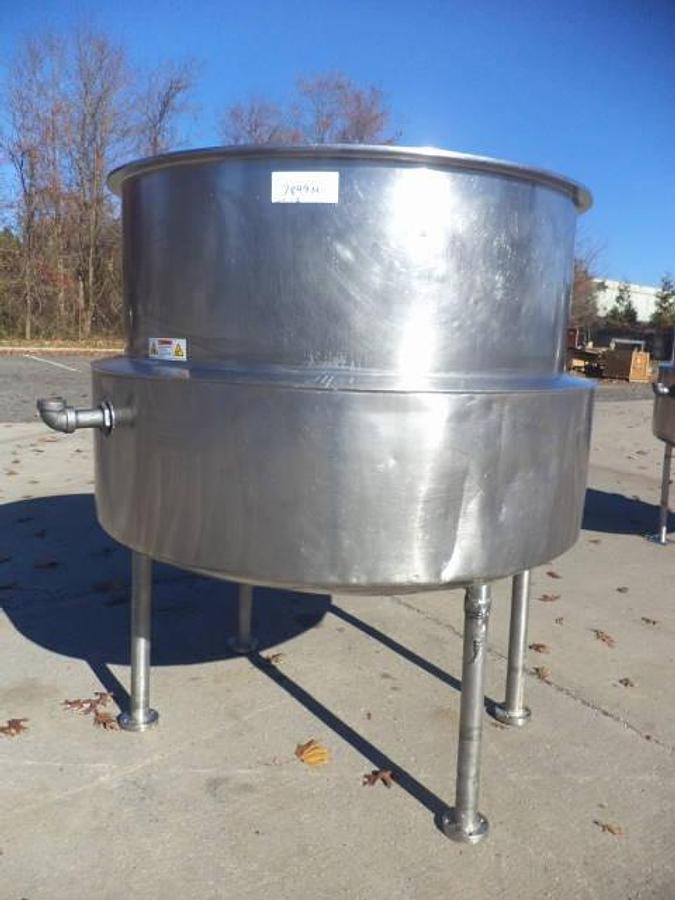
A jacketed stainless steel kettle is an industrial-grade vessel designed for heating, cooking, mixing, or processing large volumes of liquid or semi-liquid products. The jacket refers to a secondary outer chamber that surrounds the main vessel, allowing steam or hot water to circulate and apply indirect, even heat to the contents inside. This design is standard in food processing, pharmaceutical manufacturing, brewery operations, and chemical production, where precise temperature control and uniform heating are critical to product quality.
The jacketed design offers significant advantages over direct-fire heating. Because heat is applied indirectly through the jacket rather than directly to the vessel wall, there is far less risk of scorching or burning sensitive products. This makes jacketed kettles especially well suited for cooking sauces, dairy products, confections, soups, and similar items at scale. The stainless steel construction is preferred in sanitary applications because it resists corrosion, does not react with food or chemical products, and can be thoroughly cleaned between batches.
What does a 42 PSI jacket rating mean on an industrial kettle?
The jacket pressure rating on an industrial kettle indicates the maximum allowable working pressure (MAWP) that the jacket chamber is designed to safely handle. A 42 PSI rating means the jacket can operate with steam or pressurized hot water up to 42 pounds per square inch. This rating is established during the design and fabrication of the vessel and is typically verified through pressure testing before the kettle enters service. Operating a jacket beyond its rated pressure is a serious safety hazard and should always be avoided.
For practical purposes, the jacket PSI rating also gives buyers a sense of the maximum steam temperature the kettle can work with, since steam pressure and temperature are directly related. At 42 PSI, steam reaches temperatures well above the boiling point of water, which is sufficient for most food processing and light industrial applications. Buyers evaluating a used kettle should confirm that the jacket has been maintained properly and has not been subjected to pressure events that could compromise its integrity. Consulting with a qualified engineer or boiler inspector before putting a used pressure-rated vessel back into service is strongly advisable.
What should buyers look for when purchasing a used stainless steel industrial kettle?
Buying a used industrial kettle requires a more thorough evaluation than purchasing standard equipment, because the vessel's history directly affects both its safety and its remaining service life. The most important areas to inspect are the jacket integrity, the condition of the interior vessel walls, the seals and gaskets, any agitator or mixing components, and the inlet and outlet fittings. Pitting, corrosion, weld repairs, or signs of previous leaks are all red flags that warrant closer scrutiny. For jacketed kettles with a pressure rating, buyers should also ask whether the vessel has a current ASME certification or has been inspected by a qualified pressure vessel inspector.
Beyond the physical condition of the kettle itself, buyers should consider the age and model carefully when assessing what level of manufacturer support to expect for replacement parts. Older models may have limited parts availability, which can affect long-term maintenance costs. Reputable used equipment dealers will typically accommodate in-person or video inspections so buyers can assess the machine's condition before committing to a purchase. Keep in mind that used equipment is sold as-is, so the burden of inspection falls on the buyer. Selecting a dealer with a long track record in industrial food or processing equipment is one of the most effective ways to reduce risk in a used kettle purchase.
What capacity is typical for an industrial jacketed kettle, and how is it measured?
Industrial jacketed kettles are manufactured across a wide range of capacities, commonly from around 10 gallons on the small end up to several thousand gallons for large-scale production facilities. Capacity is measured in gallons or liters and refers to the working volume of the inner vessel, not including the jacket. A 350-gallon kettle, for example, is considered a mid-to-large-scale unit well suited for commercial food production, institutional cooking, or batch processing operations that require high throughput.
When evaluating capacity, buyers should consider not just the total volume but also the practical working fill level, since most kettles should not be filled to their absolute maximum during operation. Overfilling can cause spillage, uneven heating, and in some cases safety issues with pressurized jackets. The physical footprint of the kettle also scales with capacity, so facility ceiling height, floor space, and the ability to load and unload the vessel are all practical factors to account for before purchasing a large-capacity unit.
What grade of stainless steel is typically used in food-grade industrial kettles?
The most common stainless steel grades used in food-grade industrial kettles are 304 and 316 stainless steel, both of which fall under the broader 18/8 or 18/10 classification referring to their chromium and nickel content. Type 304 is the industry standard for most food processing applications. It offers excellent corrosion resistance, is easy to clean and sanitize, and does not react with most food products. Type 316 adds molybdenum to the alloy, which provides superior resistance to chlorides and acidic environments, making it the preferred choice for dairy, seafood, and applications involving salt or acidic ingredients.
Food-grade stainless steel is valued not only for its corrosion resistance but also for its smooth, non-porous surface, which resists bacterial growth and is compatible with CIP (clean-in-place) sanitation systems. Buyers evaluating used kettles should verify the stated material grade when possible, particularly if the kettle will be used in a regulated food or pharmaceutical environment. Scratches, deep pitting, or surface contamination from improper prior use can compromise the hygienic properties of even high-quality stainless steel, so a thorough interior inspection is always worthwhile.
How does the inspection process work when buying a used industrial kettle?
Used equipment dealers typically offer buyers the option to inspect machinery in person, via live video call, or through recorded video walkthroughs of the equipment. The goal of any inspection is to get an accurate picture of the machine's current condition, including visible wear, any repairs or modifications, and the operational status of key components. For a jacketed kettle, a thorough inspection should cover the interior vessel surface, the jacket connections, agitator function if applicable, and any instrumentation such as pressure gauges or temperature sensors.
One important limitation to understand is that most used equipment dealers do not have the permitting or production infrastructure to run a full operational test with actual product. The kettle may be inspected statically or with basic mechanical checks, but a live production run is generally not possible in a dealer setting. In some cases, equipment that is still installed at a manufacturing facility may be inspected while in production or shortly after decommissioning, which can provide more insight into its working condition. Buyers should ask their dealer specifically what type of inspection is available for a given piece of equipment and request as much documentation and visual evidence as possible before finalizing a purchase.
What are the typical shipping and rigging considerations for a large industrial kettle?
Shipping a large industrial kettle is a logistically complex process that involves significantly more planning than standard freight. The weight and size of a unit like a 350-gallon stainless steel kettle typically require flatbed or specialized freight transport, and the kettle must be properly secured, palletized, or crated to prevent damage in transit. Inadequate packaging is one of the most common causes of damage during equipment shipping, so buyers should ask their dealer specifically how the machine will be prepared for transport and what level of crating or blocking is included in the quoted price.
Beyond packaging, large kettles often require professional rigging for both loading at the dealer's facility and unloading at the buyer's location. Rigging involves the use of forklifts, cranes, or specialized lifting equipment to safely move heavy vessels, and this service typically carries an additional cost. Buyers should request a fully itemized breakdown of shipping costs that includes packaging, rigging, freight, and any fuel surcharges or liftgate fees, so there are no surprises in the total landed cost of the equipment. If the buyer's facility lacks a loading dock or overhead crane, making arrangements for unloading in advance is essential.
What are common applications for a 350-gallon jacketed kettle in food production?
A 350-gallon jacketed kettle is a versatile piece of equipment used across a wide range of food and beverage production applications. At this scale, it is commonly found in commercial sauce and condiment manufacturing, soup and broth production, jam and preserve processing, candy and confectionery cooking, and large-scale catering or institutional food service. Breweries and distilleries also use jacketed kettles for mashing, wort production, and similar batch processes. The jacketed design makes it particularly effective for any application where temperature must be maintained precisely over an extended period without direct flame contact.
Beyond food production, 350-gallon jacketed kettles are also used in cosmetic and personal care manufacturing, pharmaceutical compounding, and certain chemical processing applications. The specific suitability of a used kettle for a given application depends on its material grade, the condition of the interior surface, the type of agitator (if any), and whether the vessel meets the sanitary standards required by the relevant industry. Buyers should evaluate these factors carefully against their production requirements before purchasing.
What payment terms should buyers expect when purchasing used industrial equipment?
Most used equipment dealers require payment in full before a machine is released for shipping. This is standard practice in the industry and reflects the nature of the used equipment market, where machines are sold as-is and dealers need to ensure payment is secured before incurring the costs of rigging, packaging, and freight. Accepted payment methods vary by dealer but commonly include wire transfer, ACH, or certified funds. Credit card payments, if accepted, may carry a processing fee.
Some dealers extend payment terms to repeat customers or buyers with an established purchasing history, but this is the exception rather than the rule for first-time transactions. Buyers who need financing for larger equipment purchases may want to explore third-party equipment financing options, as some lenders specialize in used industrial machinery. Before finalizing any purchase, it is worth clarifying the exact payment requirements, the timeline from payment to shipping, and any conditions under which a refund or credit might be issued if a significant discrepancy is found between the machine as described and its actual condition upon arrival.
How should buyers assess the remaining service life of a used industrial kettle?
Assessing the remaining service life of a used jacketed kettle involves evaluating several factors: the age of the vessel, its maintenance history, the condition of pressure-bearing components, and the environment in which it was previously operated. Stainless steel kettles are known for their longevity, and well-maintained units can remain in productive service for decades. However, a kettle that was used in a highly acidic or corrosive environment, or one that was poorly maintained, may show significant wear well before the end of a typical service life. Asking the dealer for any available service records or documentation of prior use is a reasonable starting point.
For pressure-rated jacketed vessels, the condition of the jacket itself is particularly important. Corrosion, leaks, or evidence of prior repairs to the jacket should be carefully evaluated, ideally with input from a qualified pressure vessel inspector. Buyers should also contact the manufacturer to understand what level of technical support and parts availability they can expect for the specific model and age of the unit. Older or discontinued models may have limited manufacturer support, which is an important factor in estimating long-term operating costs. A thorough pre-purchase inspection, combined with realistic expectations about the as-is nature of used equipment, gives buyers the best foundation for making an informed decision.