Category
Manufacturer
Model
FAQ:
What is a Bartelt HMC packaging machine and what is it used for?
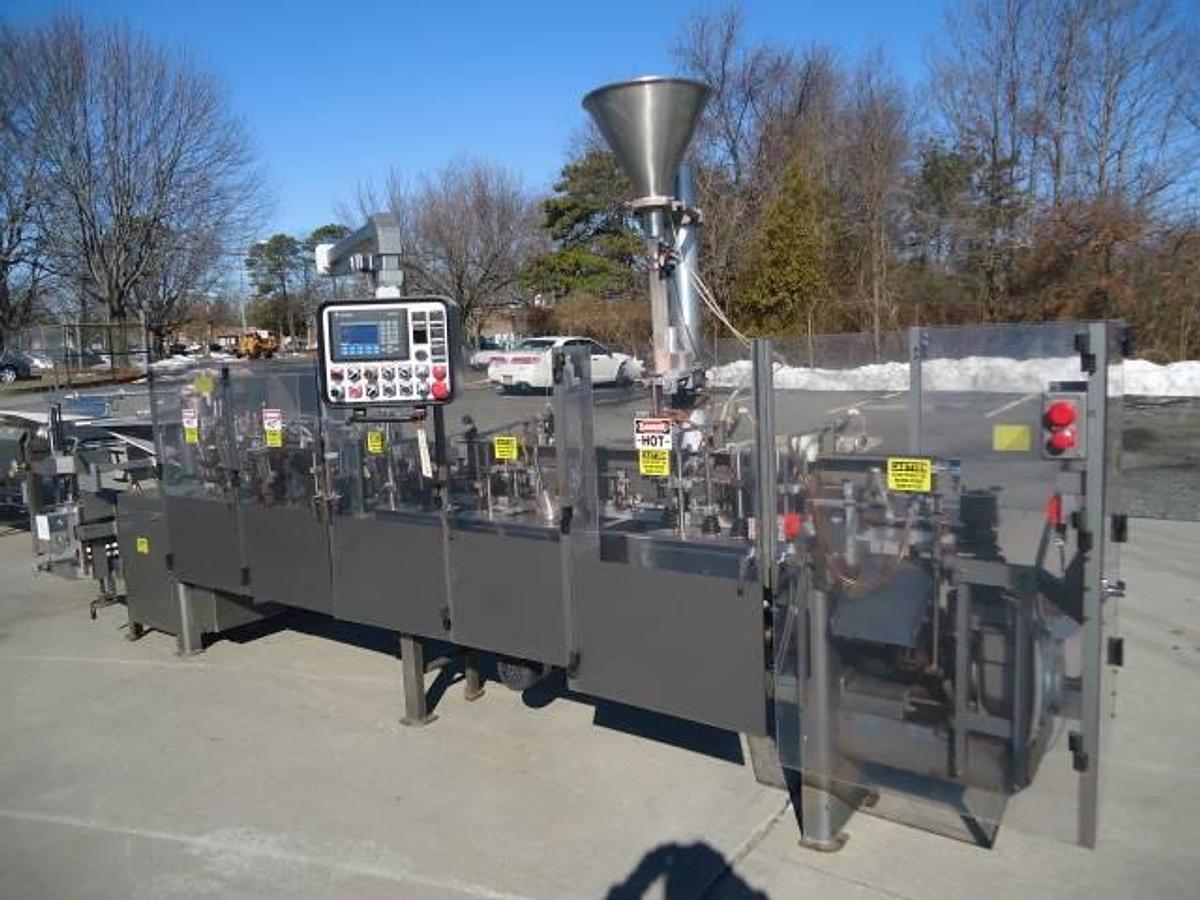
The Bartelt HMC is a horizontal form/fill/seal packaging machine designed primarily for pre-made pouch filling and sealing operations. These machines are built to handle a wide range of pouch formats including stand-up pouches, flat pouches, and gusseted bags, making them a practical choice across food processing, pet food, hardware, and consumer goods manufacturing. The HMC designation refers to the horizontal motion configuration, which moves pouches through the machine in a horizontal path while filling and sealing stations perform their respective functions at each indexed position.
Bartelt HMC machines have earned a reputation for mechanical durability that is somewhat unusual even by industrial standards. Many units manufactured in the 1980s and 1990s remain in active production use today, which speaks to the quality of the original engineering and the availability of replacement parts that has sustained these machines well beyond their initial service life. This longevity is a significant reason why the used market for Bartelt HMC equipment remains active, with buyers ranging from small contract packagers to large consumer goods manufacturers looking to add capacity without the capital expense of purchasing new equipment.
What types of products can be packaged on a Bartelt HMC machine?
The Bartelt HMC platform is versatile enough to handle a broad range of product categories. In the food industry, these machines are commonly used for dry products like coffee, snacks, nuts, dried fruit, and seasoning blends, as well as pet food, treats, and similar granular or chunk-style products. Beyond food, the machines are well-suited for hardware items such as fasteners, small parts, and other non-food consumer goods that benefit from resealable or tamper-evident pouch packaging.
The machine's compatibility with different fill systems is a key part of its flexibility. Depending on the tooling and attachments installed, a Bartelt HMC can be configured to work with auger fillers, volumetric cup fillers, weigh fillers, and liquid fill systems, which expands the range of product types it can handle. Some units also come equipped with zipper attachment systems, as seen on the Bartelt/HMC IM 9-10 model, which adds resealable closure capability to the finished pouch. Buyers evaluating a specific used machine should confirm which fill system and attachments are included, since this directly affects what products can be run without additional investment in tooling or ancillary equipment.
What production speeds can you expect from a Bartelt HMC packaging machine?
Production throughput on a Bartelt HMC machine typically falls in the range of 20 to 80 pouches per minute, though the actual speed achieved in practice depends on several interacting variables. Pouch size is one of the most significant factors, as larger pouches require more fill time and slower indexing. Product characteristics also matter considerably, since free-flowing dry products fill faster than sticky, wet, or irregularly shaped items. The fill method itself, whether auger, cup, or scale, introduces its own speed ceiling based on the equipment attached to the machine.
Buyers should treat published speed specifications as a ceiling rather than a guaranteed operating rate. Real-world production speeds are often lower than theoretical maximums once factors like changeover time, minor jams, sealing dwell requirements, and product-specific adjustments are accounted for. When evaluating a used Bartelt HMC, it is worth asking the seller or the facility where the machine was last in production what speeds were actually being achieved on the specific product and pouch format it was running. This gives a much more realistic picture of what to expect than relying on the machine's rated capacity alone.
What is the typical price range for a used Bartelt HMC packaging machine?
Pricing for used Bartelt HMC machines varies considerably based on model, age, condition, and what tooling or attachments are included with the sale. At the lower end of the market, older machines in as-is condition with limited tooling can be found in the range of $10,000 to $25,000. Mid-range units in good mechanical condition with a reasonable set of tooling for common pouch sizes tend to fall between $25,000 and $50,000. Well-maintained machines with newer electrical systems, multiple tooling sets, and desirable attachments like zipper applicators can reach $75,000 or more.
Beyond the purchase price, buyers should factor in the full landed cost before making a decision. Rigging, crating, freight, and any electrical or mechanical reconditioning needed after delivery can add meaningfully to the total investment. A machine priced attractively at $15,000 may ultimately cost $25,000 or more once shipping and required repairs are included. Working with a reputable used equipment dealer who specializes in packaging machinery is one of the better ways to get an accurate picture of total cost, since experienced dealers can help identify what a machine will need before it goes back into production and can provide detailed quotes on packaging and shipping costs upfront.
What pouch styles and sizes can a Bartelt HMC machine handle?
Bartelt HMC machines are designed to work with pre-made pouches rather than forming them from roll stock, which is an important distinction for buyers coming from form/fill/seal backgrounds. The machine accepts pouches that have already been manufactured and supplied on reels or in bulk, then opens, fills, and seals them inline. Compatible pouch formats include three-side seal flat pouches, stand-up pouches with a bottom gusset, and gusseted bag formats. Some configurations can also handle pouches with zipper closures when the appropriate attachment is installed.
The range of pouch sizes a specific machine can run is determined by the tooling installed. Tooling sets are typically configured for a defined range of pouch widths and depths, and switching between significantly different sizes requires a changeover to different tooling. When buying a used Bartelt HMC, the tooling included with the machine is a critical part of the value assessment. A machine sold with tooling that matches the buyer's target pouch dimensions can go into production much faster and at lower additional cost than a machine that requires new tooling to be fabricated. Buyers should request a detailed list of all tooling included and confirm the pouch dimensions each set is designed to run.
Are parts and technical support still available for Bartelt HMC machines?
Parts availability for Bartelt HMC machines is a legitimate consideration given that many of these machines are several decades old. The Bartelt brand has gone through ownership changes over the years, and buyers should contact the current manufacturer or authorized service network directly to understand what level of support is available for the specific model and serial number they are considering. Age and model generation can have a significant impact on whether factory parts are still stocked, whether drawings and documentation are accessible, and whether factory-trained technicians are available for support.
That said, the mechanical simplicity and durability of the Bartelt HMC platform has contributed to a secondary market for parts through third-party suppliers and other used equipment dealers. Many components such as grippers, sealing jaws, cam followers, and drive components can be sourced through industrial parts distributors or machined to specification by competent machine shops. Before purchasing a used Bartelt HMC, it is worth consulting with the manufacturer about parts availability for that specific model and also speaking with packaging equipment service companies in your region who have experience with the Bartelt platform. Understanding the support landscape ahead of time helps avoid situations where a machine sits idle due to a part that is difficult or expensive to source.
What is the difference between the Bartelt HMC IM 9-10 and other Bartelt HMC models?
The Bartelt HMC line includes several model variants that differ primarily in their indexing configuration, number of fill stations, and the range of pouch sizes and formats they can accommodate. The IM designation on models like the IM 9-10 refers to the intermittent motion operating principle, meaning the machine indexes pouches through each station in a stop-and-go cycle rather than continuously. This intermittent motion design is well-suited for products that require a defined dwell time at the fill and seal stations, which is common for pouches requiring heat sealing at controlled temperatures.
The numeric designations in the model name typically relate to the number of pouch stations or the pouch size range the machine is designed to handle. The IM 9-10, for example, is configured for a specific range of pouch widths and depths that falls within the 9 to 10 inch range. Higher-numbered models generally accommodate larger pouches or offer additional stations for more complex operations. Some Bartelt HMC models also come with optional zipper attachment systems that apply and close resealable zippers as part of the filling cycle, which adds functionality for consumer products that benefit from reclosable packaging. When comparing models, buyers should look closely at the pouch size range, maximum fill volume, speed rating, and what optional stations or attachments are included or available for that specific configuration.
How much operator training is required to run a Bartelt HMC packaging machine?
The Bartelt HMC is generally considered a machine that experienced packaging operators can learn to run with a reasonable amount of training, but it is not a plug-and-play piece of equipment for someone with no background in packaging machinery. The intermittent motion design and the mechanical nature of the indexing, filling, and sealing systems mean that operators need to understand how to set up the machine for a specific pouch format, make adjustments to seal temperature and dwell time, and troubleshoot common issues like misfeeds, incomplete seals, or fill weight variation. These skills take time to develop and are best transferred through hands-on training with someone who has direct experience on the Bartelt platform.
For buyers purchasing a used Bartelt HMC, sourcing operator training can take a few different paths. Some used equipment dealers with deep experience in packaging machinery can provide basic operational guidance as part of the sale. The manufacturer or authorized service network may offer training programs, though availability can vary depending on the age of the machine. Third-party packaging equipment service companies that specialize in horizontal pouch machines are another option and can often provide on-site startup assistance and operator training. Investing in proper training at the time of installation is worth the cost, as it reduces startup time, minimizes the risk of damaging tooling or pouches during the learning curve, and helps operators recognize early signs of mechanical issues before they become costly problems.
What should buyers inspect before purchasing a used Bartelt HMC machine?
A thorough inspection of a used Bartelt HMC should cover both the mechanical and electrical systems of the machine. On the mechanical side, key areas to evaluate include the condition of the sealing jaws and their heating elements, the gripper chains and individual gripper assemblies, the cam and drive system, the fill station components, and the overall frame and guarding. Worn or damaged grippers are one of the more common issues on high-cycle machines, and replacing a full set can be a meaningful expense. Sealing jaws should be checked for flatness and even heat distribution, since compromised jaws directly affect seal quality and finished package integrity.
Electrical systems on older Bartelt HMC machines can present their own challenges, particularly on units that have not been updated since manufacture. Obsolete PLCs, relay-based control panels, and aging servo or stepper drive components can be difficult and expensive to repair or replace. Buyers who are not qualified to assess electrical systems themselves should consider bringing in a packaging equipment technician to evaluate the controls during an inspection. Reputable used equipment dealers will typically accommodate in-person inspections or provide detailed video walkthroughs of the machine in its current state. Some machines may still be installed at the facility where they were last used, which can allow for a live demonstration under power. Keep in mind that most dealers are not set up to run actual product through the machine, so the inspection will generally focus on mechanical condition and powered operation rather than a full production trial.
What are the shipping and logistics considerations when buying a used Bartelt HMC machine?
Bartelt HMC machines are substantial pieces of industrial equipment, and getting one from a seller's facility to a buyer's plant requires careful planning. The machine needs to be properly rigged for loading, which typically involves a forklift or crane depending on the machine's weight and the configuration of the seller's facility. Once loaded, the machine should be crated or palletized in a way that protects it from movement and vibration damage during transit. The level of packaging required, whether a basic pallet with strapping or a full wooden crate with blocking and bracing, affects both the cost and the protection level during shipping.
Buyers should request a detailed breakdown of all costs associated with getting the machine delivered before committing to a purchase. This includes rigging at the origin facility, packaging and crating, freight to the destination, and any rigging required for unloading and placement at the buyer's plant. For larger or heavier configurations, flatbed trucking and specialized rigging equipment may be necessary, which adds to the total cost. Understanding the full landed cost upfront is important because freight and rigging expenses can be significant relative to the purchase price of the machine, particularly for buyers located far from the seller. Most used equipment dealers require full payment prior to shipping, so all cost components should be confirmed and agreed upon before payment is made.