Category
Manufacturer
Model
FAQ:
What industries commonly use Azo Bauermeister grinding mills?
Azo Bauermeister grinding mills are used across a wide range of processing industries, with the strongest concentration in food production, pharmaceuticals, and industrial chemicals. In food manufacturing, these mills handle materials like spices, sugar, flour, cocoa, and dried vegetables, where consistent particle size and hygienic construction are critical. Pharmaceutical manufacturers rely on them for active ingredient milling and excipient processing, where GMP compliance and cleanability directly affect product quality and regulatory standing. Chemical processors also use them for pigments, resins, and specialty powders that require precise size reduction without contamination.
Beyond those three core sectors, Azo Bauermeister mills appear in cosmetics manufacturing, nutraceuticals, and agricultural chemical processing. The stainless steel construction and explosion-proof configurations available on certain models make them adaptable to environments where dust ignition risk is a concern. Because the Bauermeister brand merged under the Azo group, buyers also benefit from the broader Azo ecosystem of sieving and conveying equipment, which means these mills can often slot into larger integrated processing lines rather than operating as standalone units. That integration capability is part of what makes them a recurring choice in facilities that process dry bulk materials at scale.
What are the key differences between Azo Bauermeister mill models like the UM, UPZ, and CW series?
The Universal Mill (UM), Universal Pin Mill (UPZ), and Classifier Mill (CW) each target different particle size reduction requirements and material characteristics, so choosing between them depends heavily on the specific application. The Universal Mill is a versatile impact mill designed for medium-fine grinding across a broad range of materials. It typically uses interchangeable grinding inserts, such as beater plates or pin discs, which allows operators to adapt the same machine to different products without major reconfiguration. This flexibility makes the UM a popular choice in facilities that process multiple material types.
The Universal Pin Mill (UPZ) is built for finer, more controlled grinding and uses opposing rows of pins to break down particles through impact. It excels with friable, non-fibrous materials and can achieve tighter particle size distributions than a standard impact mill. The Classifier Mill (CW) takes this further by integrating an internal air classifier directly into the grinding chamber, which continuously separates oversized particles and returns them for further reduction. This closed-loop design allows the CW series to produce very fine, narrow-distribution powders without a separate classification step, making it well suited for pharmaceutical and specialty chemical applications where tight specifications are non-negotiable. Buyers evaluating used machines should identify which series fits their target particle size and material before purchasing, since the grinding mechanisms differ significantly between models.
What particle size ranges can Azo Bauermeister mills typically achieve?
Azo Bauermeister mills cover a broad spectrum of particle size reduction, generally producing finished powders in the range of 20 to 500 microns depending on the model, configuration, and material being processed. Coarser outputs in the 300 to 500 micron range are achievable with standard impact or pin mill setups running at lower speeds or with wider gap settings. Finer outputs, down toward 20 to 50 microns, typically require classifier mill configurations or pin mill setups paired with external classification equipment. The actual result for any given material also depends on feed particle size, moisture content, hardness, and whether the mill is operating in open or closed circuit.
For buyers considering a used Azo Bauermeister mill, it is worth noting that particle size performance can vary from published specifications if internal components like pins, beater plates, or classifier wheels show wear. During an inspection, asking about the condition of grinding elements and requesting any available test data from the selling facility can give a clearer picture of what the machine is currently capable of delivering. If the machine is still in production at its current location, arranging an in-person or video inspection while it is running can provide the most realistic assessment of its output quality before purchase.
What materials can Azo Bauermeister grinding mills process?
Azo Bauermeister mills are designed primarily for dry, free-flowing materials that are friable or moderately hard. Common applications include spices, sugar, salt, flour, cocoa powder, dried dairy products, pharmaceutical powders, chemical intermediates, pigments, and resins. The stainless steel construction on most models makes them compatible with food-grade and pharmaceutical materials where metal contamination or hygiene is a concern. Certain configurations also handle mildly abrasive materials, though highly abrasive products can accelerate wear on grinding elements and may require more frequent component inspection.
Materials that are fibrous, sticky, or high in fat content can pose challenges for standard mill configurations. Fibrous products like certain herbs or plant-based ingredients tend to resist impact grinding and may require specialized rotor and screen combinations. High-fat materials can cause buildup on grinding surfaces, affecting output particle size and requiring more frequent cleaning cycles. Buyers purchasing a used Azo Bauermeister mill should clearly define their target material before selecting a model, since the internal tooling, rotor type, and screen or classifier configuration all influence which materials the machine handles effectively. Consulting with the manufacturer directly about the specific model and age can help clarify which materials are well suited and what level of support is available for that particular machine.
What certifications and compliance standards do Azo Bauermeister grinding mills meet?
Azo Bauermeister mills are frequently built to meet food-grade and pharmaceutical GMP (Good Manufacturing Practice) standards, which govern material contact surfaces, cleanability, and documentation requirements. Stainless steel construction, smooth interior surfaces, and tool-free disassembly for cleaning are common design features that support GMP compliance. Many models are also available in ATEX-rated configurations, which certifies them for use in potentially explosive atmospheres created by combustible dust. ATEX certification is particularly relevant in food and chemical processing environments where fine dry powders can create ignition risk.
For buyers acquiring used Azo Bauermeister equipment, it is important to verify which certifications applied to the specific machine being purchased and whether any modifications made after the machine left the manufacturer may have affected its compliance status. Certification documentation does not automatically transfer with a used machine in all regulatory contexts, so buyers operating in regulated industries should consult with their compliance teams and, where appropriate, contact the manufacturer to determine what documentation or recertification may be needed. The age and model of the machine can also affect the level of support the manufacturer is able to provide, so reaching out to Azo Bauermeister directly to discuss a specific serial number or model is a practical step before finalizing a purchase.
What should buyers inspect when evaluating a used Azo Bauermeister grinding mill?
A thorough inspection of a used Azo Bauermeister mill should cover several key areas: the condition of the grinding elements (pins, beater plates, or classifier wheels depending on the model), the integrity of the mill housing and any seals or gaskets, the drive motor and its electrical components, and the overall cleanliness of the machine interior. Wear on grinding elements directly affects particle size output, so any visible pitting, rounding of pin tips, or uneven wear patterns on impact surfaces is worth noting. Bearings should also be checked for play or noise, as bearing replacement can be a meaningful cost on larger mills.
Inspections can typically be arranged in person, via video call, or through video footage provided by the dealer. Some machines may still be installed and running at their current facility, which allows for a more realistic assessment of operating condition. Keep in mind that most used equipment dealers are not set up to run actual production trials, since that requires different permitting and facility capabilities, so the inspection will generally focus on mechanical condition rather than live product testing. Buyers should ask the dealer specifically about the availability of maintenance records, any recent repairs, and the history of the materials the machine processed, since certain products can leave residue or cause wear patterns that affect future performance with different materials.
Are spare parts and replacement components available for used Azo Bauermeister grinding mills?
Parts availability for Azo Bauermeister mills depends significantly on the model and age of the machine. For relatively recent models, the manufacturer and authorized service networks can often supply grinding pins, beater plates, screens, seals, and other wear components. Older or discontinued models may have limited manufacturer support, and buyers may need to rely on aftermarket suppliers or machined replacements for certain components. Before purchasing a used mill, it is a practical step to contact Azo Bauermeister directly with the machine's model number and serial number to ask which components are still available and at what lead times.
Wear parts like grinding elements and seals are the most frequently replaced components on these mills and should be factored into the total cost of ownership calculation. If a used machine shows significant wear on internal grinding surfaces, the cost of a full set of replacement pins or beater plates can be substantial and should be considered alongside the purchase price. Dealers who specialize in size reduction and milling equipment are generally better positioned to advise on parts availability and sourcing options than general industrial equipment resellers, since familiarity with specific mill platforms helps identify which components are interchangeable across model variants and which are proprietary.
What is the typical price range for used Azo Bauermeister grinding mills?
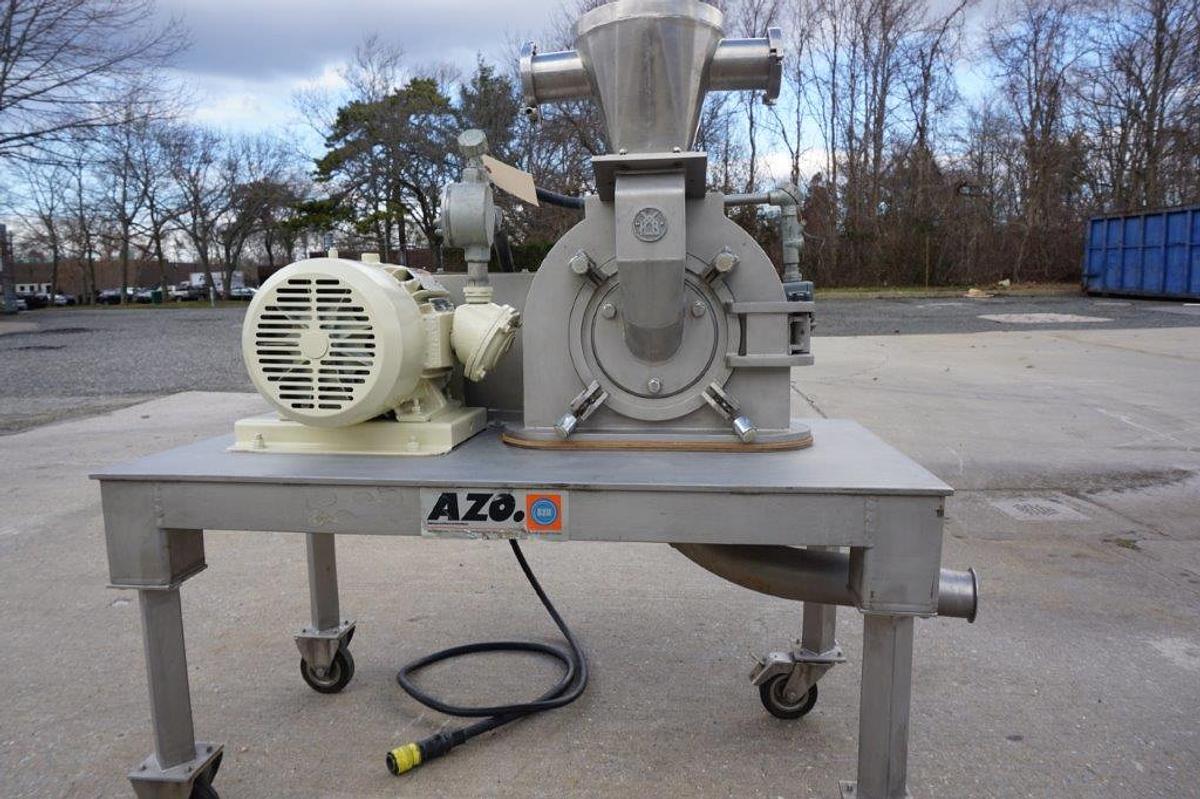
Pricing for used Azo Bauermeister grinding mills varies considerably based on model, size, age, condition, and configuration. Smaller bench-scale or pilot-scale units can be found in the lower thousands of dollars, while larger production-scale mills, particularly classifier mill configurations or fully equipped systems with controls and dust collection, can reach into the tens of thousands. A 10 HP Universal Turbo Grinding Mill in stainless steel, for example, represents a mid-range production unit, and pricing for a machine in that class will reflect its mechanical condition, the availability of its internal tooling, and current market demand for that model.
Buyers should also account for costs beyond the purchase price when budgeting for a used mill. Rigging, crating, freight, and any site installation work are typically separate from the equipment price. If internal components need replacement before the machine returns to production, those parts and labor costs add to the total investment. Getting a clear picture of the machine's current condition through inspection, and confirming parts availability with the manufacturer, helps avoid surprises after the machine arrives. Used equipment pricing in this category tends to reflect real-world condition more than list price comparisons, so a lower-priced machine in poor mechanical condition can end up costing more than a well-maintained unit priced higher upfront.
What are the typical shipping and logistics considerations when buying a used Azo Bauermeister grinding mill?
Grinding mills are heavy, precision machines that require careful handling during transit to avoid damage to bearings, seals, and grinding elements. Packaging requirements vary by machine size, with smaller mills typically shipped on pallets with appropriate blocking and bracing, while larger production units may require custom wooden crating to protect housing and drive components. Buyers should ask the dealer specifically what packaging will be used and whether that cost is included in the quoted price or billed separately, since crating charges can be meaningful for larger equipment.
Loading and unloading larger mills often requires forklift or crane rigging, which adds cost and coordination at both the origin and destination. Buyers should confirm their facility has the necessary equipment to receive the machine safely before shipping is arranged. Freight costs depend on machine weight, dimensions, origin, destination, and the shipping mode selected. For international purchases, import duties, customs clearance fees, and compliance with destination country electrical standards are additional factors to plan for. Most used equipment dealers require full payment before the machine ships, so understanding the complete landed cost, including equipment price, packaging, rigging, and freight, before committing to a purchase helps avoid budget overruns.
How does buying a used Azo Bauermeister mill compare to purchasing new milling equipment?
Purchasing a used Azo Bauermeister mill can offer significant cost savings compared to buying equivalent milling capacity through a new equipment order, often at a fraction of the price for the same platform and motor size. Lead times are another practical difference. New milling equipment from European manufacturers can involve production lead times of several months, while a used machine that is already available can be inspected, purchased, and shipped within weeks. For facilities that need to add capacity quickly or are working within a tighter capital budget, the used market is a realistic path to acquiring proven equipment.
The trade-offs are worth understanding clearly. Used machines are sold as-is, without manufacturer warranties, and the buyer takes on the responsibility of assessing condition before purchase. The age of the machine affects what level of manufacturer support is available for parts and technical guidance. Buyers should work with dealers who specialize in size reduction equipment and have a verifiable track record in the industry, since that expertise helps ensure the machine being offered is accurately represented and appropriately priced for its condition. Selecting a reputable dealer, conducting a thorough inspection, and consulting with the manufacturer about the specific model are the key steps that separate a sound used equipment purchase from a costly mistake.