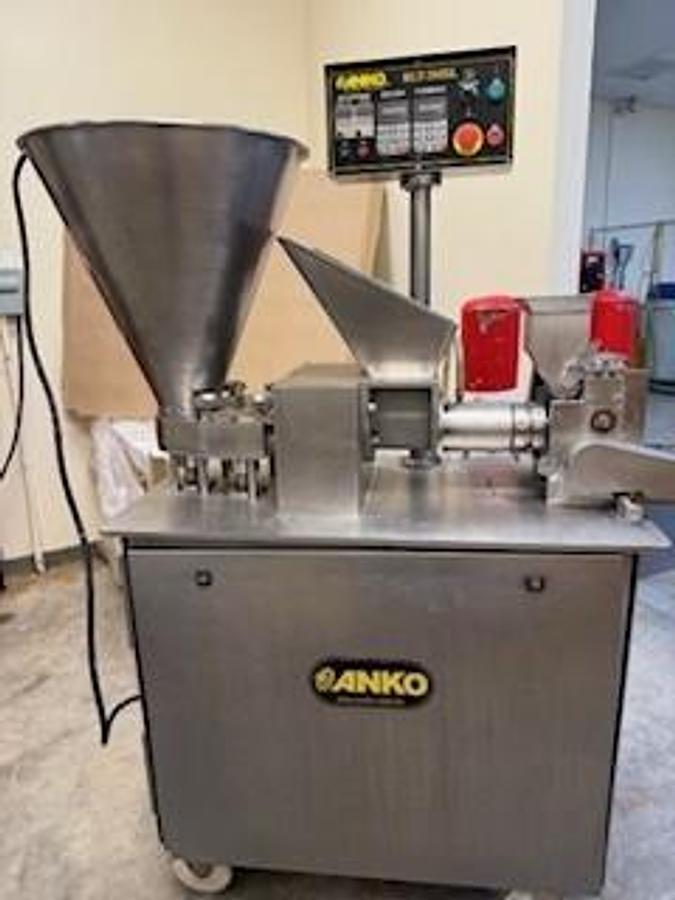
Category
Manufacturer
Model
FAQ:
What types of Anko machines are available on the used market?
Anko Food Machine Co., Ltd. produces a fairly broad lineup of commercial food-forming equipment, and several of these models circulate regularly on the used machinery market. The most commonly found units include encrusting machines, filling and forming machines, spring roll machines, dumpling machines, and multi-purpose food forming equipment. The multi-purpose filling and forming machine is one of the more sought-after models because it handles a wide variety of products without requiring a complete machine swap between runs.
Buyers shopping for used Anko equipment should pay close attention to the specific model number and configuration, since Anko has released numerous variants over the years with different die sets, capacity ratings, and automation levels. A machine listed simply as a 'filling and forming machine' could refer to several distinct models with meaningfully different output speeds and product compatibility. Asking the dealer for the exact model designation and, if possible, the original spec sheet will help confirm whether the machine suits the intended production application before any purchase decision is made.
What foods can Anko machines produce?
Anko machines are built around the concept of versatility across both Asian and Western food categories. A single machine, depending on its die set and tooling, can produce dumplings, gyoza, xiao long bao, mochi, stuffed buns (baozi), spring rolls, empanadas, samosas, pies, and a range of other filled or encrusted products. This cross-category capability is a large part of why Anko equipment became popular with food manufacturers serving diverse markets.
The key to product variety is the interchangeable tooling system. Different molds, dies, and forming heads can be swapped in to change the shape, size, and style of the finished product. When evaluating a used Anko machine, buyers should confirm exactly which tooling and die sets are included with the sale, since purchasing replacement or additional tooling separately can add meaningful cost. Some used listings include the full original tooling complement, while others may have only a partial set remaining from the machine's production history.
Are Anko machines designed for commercial or home use?
Anko machines are commercial and industrial food production equipment. They are engineered for continuous-duty operation in environments like food manufacturing plants, restaurant commissaries, bakeries, and catering operations. The machines are built from food-grade stainless steel, sized for high-volume output, and require three-phase electrical connections in most cases, which rules out typical residential settings entirely.
A used Anko machine is a significant capital investment suited to businesses producing food at scale, not hobbyists or small home kitchens. The production rates, physical footprint, and utility requirements all reflect their intended commercial environment. Buyers considering a used unit should have a clear picture of their facility's electrical capacity, floor space, and sanitation workflow before purchasing, since these machines are designed to integrate into a professional food production line rather than function as standalone countertop appliances.
What is the typical production capacity of Anko machines?
Production capacity varies significantly across Anko's different machine models and the specific product being made. Entry-level commercial models can produce several hundred pieces per hour, while higher-end fully automated encrusting and forming lines can reach outputs in the thousands of pieces per hour. The multi-purpose filling and forming machines commonly found on the used market typically fall somewhere in the mid-range, though exact figures depend on the model, the product size, and how the machine is configured.
When reviewing a used Anko machine listing, it is worth asking the dealer whether the machine's rated capacity reflects the manufacturer's specification or the actual throughput observed during its prior production life. Worn tooling, mechanical wear, or missing components can reduce real-world output below the rated figure. Requesting a video of the machine running, or arranging an in-person inspection at the facility where it was last used, gives buyers a much clearer sense of current operating condition and realistic production speed.
How easy is it to operate a used Anko machine?
Anko machines are designed with production operators in mind, and most models have relatively straightforward controls once the operator is familiar with the setup. The more complex part of operating an Anko machine is the initial setup: loading the correct tooling, calibrating the dough and filling feed rates, and adjusting forming pressure to achieve consistent product weight and shape. These adjustments require some hands-on experience, and operators who are new to the equipment typically need a learning period before production runs smoothly.
With used equipment specifically, there is an added consideration: the machine will not come with factory training or setup support the way a purchase directly from the manufacturer might. Buyers should ask whether any operational documentation, maintenance logs, or tooling guides are included with the sale. Some used equipment dealers can also facilitate video inspections that show the machine in operation, which helps new owners understand how the controls and adjustments work before the equipment arrives at their facility. Connecting with Anko's manufacturer support team is also advisable, since they can often clarify operational questions for older models and advise on parts availability.
What should I inspect before buying a used Anko machine?
A thorough inspection of a used Anko machine should cover several areas: the condition of the stainless steel food-contact surfaces, the state of the forming dies and tooling, the function of the drive motors and belts, the control panel and any electrical components, and the overall structural integrity of the frame. Worn or damaged dies are one of the most common issues with used food-forming equipment, and replacing them can be a significant added cost if they are not included or are in poor condition at the time of sale.
Most reputable used equipment dealers will accommodate in-person inspections at their facility, or can provide detailed video walkthroughs of the machine. If the machine is still installed at the facility where it was last used, an in-person inspection there may be possible, and in some cases the machine may still be in active production, allowing the buyer to observe it running under real conditions. Keep in mind that dealers generally do not have the permitting or production infrastructure to run test batches of actual food product, so inspections focus on mechanical function and condition rather than finished product output. Buyers should also contact Anko directly to understand what parts and technical support are available for the specific model they are considering, since older or discontinued models may have more limited support.
Do used Anko machines come with a warranty?
Used Anko machines are typically sold on an as-is basis, which is standard practice across the used commercial food equipment market. Manufacturer warranties are tied to the sale of equipment directly from the manufacturer and do not transfer to subsequent buyers through the secondary market. This places the responsibility of assessing machine condition squarely on the buyer prior to purchase, which is why inspection is such a critical step in the process.
The practical implication is that buyers should invest time upfront in evaluating the machine's condition rather than relying on post-purchase protection. Choosing a dealer with a long track record in the food equipment industry, and one that specializes in this category of machinery, reduces risk considerably. A reputable dealer will be transparent about the machine's history and condition, facilitate thorough inspections, and be reachable after the sale if questions arise. Buyers should also reach out to Anko's manufacturer support to understand the level of technical assistance and parts availability they can expect for the specific model and age of machine they are purchasing.
How are used Anko machines shipped, and what does it cost?
Shipping costs for used Anko machines depend on the size and weight of the specific model, the origin and destination, and the level of packaging or crating required to protect the machine in transit. Smaller filling and forming machines may ship on a standard pallet, while larger or more complex units may require custom wooden crating to prevent damage during freight handling. Rigging costs for loading and unloading heavier machines are typically separate from the freight charge and should be factored into the total landed cost.
Buyers should ask the dealer for a detailed breakdown of packaging, rigging, and freight costs before finalizing a purchase. The difference between a palletized shipment and a fully crated one can be meaningful, and heavier machines may require a liftgate or forklift at the delivery location, which adds further cost if the buyer's facility is not equipped for it. Getting a clear picture of all shipping-related expenses upfront avoids surprises and allows for an accurate comparison of total acquisition cost across different listings.
What payment terms are typical when buying a used Anko machine?
The standard practice in the used commercial equipment market is full payment prior to shipment. Most dealers require this regardless of the buyer's size or purchase history, since the risks associated with releasing equipment before payment is cleared are significant. Some dealers may extend payment terms to established repeat customers, but this is the exception rather than the rule and is typically negotiated on a case-by-case basis.
Buyers who are unfamiliar with a particular dealer should treat full prepayment as the expected requirement and plan accordingly. This makes the dealer selection process especially important: because payment is made before the machine ships, buying from a dealer with a verifiable track record and industry reputation is a meaningful risk-reduction step. Checking for references, reviewing the dealer's history in the food equipment space, and confirming that inspection options are available before payment is finalized all contribute to a more secure transaction.
How does buying a used Anko machine compare to buying one directly from the manufacturer?
Buying a used Anko machine through the secondary market typically comes at a significantly lower price point than purchasing through the manufacturer, which makes used equipment an appealing option for businesses looking to scale production without the capital outlay of buying new. The trade-off is that used machines come without factory setup support, training programs, or manufacturer-backed coverage, and the buyer takes on the responsibility of verifying condition and ensuring the machine fits their production needs.
There are also practical differences in lead time and configuration. Manufacturer orders for commercial food equipment can involve lead times of several months depending on model and customization. A used machine that is already built and available can often be shipped and installed much faster, which matters for businesses trying to expand capacity quickly. The key due diligence steps for used purchases, including thorough inspection, verification of included tooling, and a conversation with Anko about parts and support for the specific model, help close the information gap that comes with buying equipment that has a prior production history.