Category
Manufacturer
Model
Airflow Systems
Airflow Systems manufactures air filtration and dust collection systems, catering to industries including woodworking, metalworking, and manufacturing. Their equipment is popular in maintaining clean air environments and managing industrial dust and contaminants, enhancing workplace safety and compliance with air quality standards.
FAQ:
What industries commonly use Airflow Systems dust collectors?
Airflow Systems dust collectors are used across a wide range of industrial and commercial settings, with woodworking, metalworking, and general manufacturing being the most common applications. In woodworking shops, these units manage fine sawdust and shavings that accumulate quickly during cutting, sanding, and routing operations. In metalworking environments, they capture grinding dust, metal particulate, and fumes that pose both health and fire risks. General manufacturing facilities rely on them to maintain air quality standards and comply with OSHA and EPA regulations governing airborne contaminants.
Beyond those core industries, Airflow Systems equipment also appears in cabinet shops, furniture production facilities, and light industrial plants where maintaining a clean air environment is both a safety requirement and a practical necessity. The brand has built a strong reputation in settings where consistent, reliable dust capture is non-negotiable, making their used equipment a sought-after option for facilities looking to upgrade or expand dust collection capacity without the cost of purchasing unused machines.
What should I look for when buying a used Airflow Systems dust collector?
When evaluating a used Airflow Systems dust collector, the three most important technical factors are CFM (cubic feet per minute) rating, filtration efficiency, and motor horsepower. CFM determines how much air volume the unit can move, which directly affects whether it can keep up with the dust load generated by your equipment. A general rule of thumb is to size the collector so it can handle at least 350 CFM per connected machine, though high-production environments often require significantly more. Filtration efficiency, measured in microns, tells you how fine a particle the unit can capture. For fine dust like MDF or drywall, you want filtration rated at 1 micron or finer.
Beyond the specs, physical condition matters a great deal with used equipment. Check the filter bags or cartridges for tears, clogging, or heavy wear, since replacement filters can be a meaningful added cost. Inspect the impeller and motor housing for signs of corrosion, impact damage, or excessive wear. Ask the seller about the machine's service history and the environment it operated in, since a collector used in a metalworking shop will have experienced different stresses than one used in a woodworking facility. Requesting a video inspection or in-person walkthrough before purchasing is a smart step that reputable used equipment dealers will readily accommodate.
What is the difference between a single-stage and two-stage dust collector?
A single-stage dust collector pulls all material, including large chips, heavy debris, and fine dust, directly through the impeller and into a collection bag or bin. This design is simpler and often less expensive, but the impeller takes a beating from larger particles over time, which can shorten its service life. Single-stage units are adequate for light-duty applications or shops with lower dust volumes, but they tend to require more frequent filter cleaning because all particulate loads the filter directly.
A two-stage dust collector adds a separator (typically a cyclone or a pre-separator drum) before the impeller. Heavy chips and coarse debris drop out in the first stage before the airstream ever reaches the filter or impeller, which dramatically extends filter life and reduces wear on the motor and impeller assembly. Serious woodworkers and industrial production facilities strongly prefer two-stage systems for this reason. When shopping for used Airflow Systems equipment, understanding which design a particular unit uses will help you assess its suitability for your application and estimate ongoing maintenance costs.
How do I determine the right CFM rating for my facility?
CFM, or cubic feet per minute, is the most critical sizing factor for any dust collection system. The calculation starts with identifying every piece of equipment that will connect to the collector at the same time. Each machine has a recommended CFM requirement, which is typically listed in its manual or available from the manufacturer. You add those figures together and then factor in duct losses, which increase the CFM demand based on the length and diameter of your ductwork runs. A common starting point for individual woodworking machines is 350 to 500 CFM per tool, while larger industrial equipment like wide-belt sanders or CNC routers can demand 800 CFM or more on their own.
For facilities running multiple machines simultaneously, the total CFM requirement can climb quickly into the thousands. It is also worth building in a buffer of 20 to 25 percent above your calculated need to account for duct leakage, filter loading over time, and any future equipment additions. Used Airflow Systems dust collectors span a range of capacities, so matching the unit's rated CFM to your actual load is essential before purchase. If you are unsure, consulting with an industrial ventilation engineer or a knowledgeable used equipment dealer who specializes in dust collection can help you avoid undersizing a system.
Can Airflow Systems dust collectors handle fine dust from MDF or drywall?
Fine dust from materials like MDF (medium-density fiberboard) and drywall is among the most hazardous types of particulate in an industrial or shop environment. MDF dust contains wood fibers and urea-formaldehyde resin particles that can reach sizes well below 10 microns, small enough to penetrate deep into the lungs. Drywall dust similarly produces very fine gypsum particles. Standard 30-micron filter bags, which are common on older or entry-level dust collectors, will not capture this fine material effectively and may actually recirculate it back into the air.
For fine dust applications, you need a collector with filtration rated at 1 micron or finer, and ideally one equipped with a cartridge filter rather than a cloth bag. Some Airflow Systems models support upgraded filtration configurations that can address sub-micron dust. When buying a used unit specifically for fine dust work, confirm the filtration media currently installed and factor in the cost of upgrading it if necessary. Pairing the collector with a proper downdraft table or close-capture hood at the source will also significantly improve fine dust capture efficiency regardless of the collector's overall capacity.
What is the Airflow Systems PCH-1 Portable Dust Collector, and what is it used for?
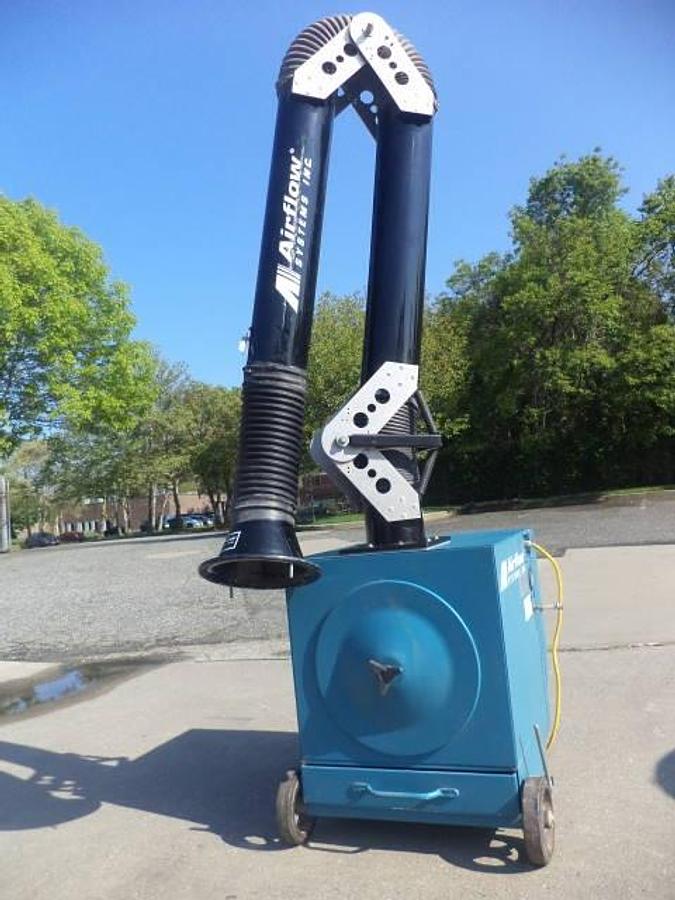
The Airflow Systems PCH-1 is a portable dust collector designed for localized dust and fume capture in industrial and commercial settings. It is often paired with an E-Z Arm extractor arm, which is a flexible or articulating capture arm that positions the collection inlet close to the dust source. This type of setup is common in welding stations, grinding areas, woodworking benches, and other workstations where a fixed duct system is impractical or where the work location changes frequently. The portability of the unit allows it to be moved between workstations as needed, making it a flexible solution for smaller shops or facilities with variable workflows.
The extractor arm configuration is particularly effective because it captures dust and particulate at the point of generation before it disperses into the room air. This approach is more efficient than relying on general ventilation and results in better air quality with a smaller, less powerful unit. Used PCH-1 units appear on the market periodically and can represent good value for shops that need targeted dust capture without investing in a full centralized system. As with any used dust collection equipment, inspecting the condition of the filter, motor, and arm mechanism before purchase is important.
How does buying a used Airflow Systems dust collector differ from buying an unused one?
The most significant practical difference is that used equipment is sold as-is, meaning there is no manufacturer coverage or dealer guarantee on performance. With unused equipment purchased directly from a manufacturer or authorized distributor, buyers typically receive some form of coverage and technical support. With used machinery, that protection is not present, which places the responsibility of evaluating condition squarely on the buyer. This makes the inspection process far more important. Reputable used equipment dealers will provide in-person inspections, video walkthroughs, or photo documentation to help buyers assess a machine's current state before committing to a purchase.
On the upside, used Airflow Systems dust collectors are typically available at a fraction of the cost of comparable unused machines, which makes them attractive for budget-conscious buyers, startups, and facilities that need additional capacity quickly. The key is selecting a dealer with a demonstrated track record in industrial equipment and specific experience with dust collection systems. Buyers should also contact Airflow Systems directly to understand what parts and technical support are available for the specific model and age of the unit they are considering, since older models may have limited parts availability.
What should I ask a used equipment dealer before purchasing a dust collector?
Before committing to a purchase, there are several practical questions worth asking. First, find out where the machine came from and what environment it operated in. A dust collector pulled from a clean woodworking shop will be in a very different condition than one that spent years in a foundry or chemical processing facility. Ask how long the unit was in service, whether it was regularly maintained, and whether any components have been replaced. Request documentation if it is available. Second, ask specifically about the condition of the filtration media, since filters are a wear item and may need immediate replacement. Get clarity on whether the unit is complete with all its original components or if anything is missing.
On the logistics side, ask about inspection options. A trustworthy dealer will offer at minimum a video inspection and ideally an in-person visit if the machine is still at a production facility. Ask about packaging, rigging requirements for loading and unloading, and shipping costs so you understand the full landed price before agreeing to buy. Payment terms should also be clarified upfront. Most used equipment dealers require full payment before a machine ships, though some may offer terms to established customers. Getting clear answers to all of these questions before purchasing protects you from unexpected costs and helps ensure the machine is a good fit for your application.
What are typical shipping and rigging considerations for used industrial dust collectors?
Shipping a used industrial dust collector involves more logistical complexity than shipping standard freight. Smaller portable units like the Airflow Systems PCH-1 can typically be palletized and shipped via common LTL (less-than-truckload) freight carriers, but larger stationary collectors may require custom crating to prevent damage during transit. The level of packaging required directly affects shipping costs, so buyers should ask dealers for specific details on how the machine will be prepared and what those preparation costs include. Inadequate packaging is one of the most common causes of transit damage on used industrial equipment.
For larger or heavier dust collection systems, rigging for loading at the origin and unloading at the destination is an additional cost that buyers sometimes overlook. This can involve forklifts, cranes, or specialized rigging crews depending on the size and weight of the unit. If the machine is being removed from an active production facility, coordinating that removal adds another layer of scheduling complexity. Buyers should get a fully itemized cost breakdown covering packaging, rigging, freight, and any fuel surcharges before finalizing a purchase, since these costs can meaningfully affect the total investment in the equipment.
How do Airflow Systems dust collectors help with workplace safety and air quality compliance?
Industrial dust is a serious occupational health hazard. Prolonged exposure to wood dust, metal particulate, and composite material dust has been linked to respiratory disease, occupational asthma, and in some cases cancer. OSHA sets permissible exposure limits (PELs) for a range of airborne contaminants, and facilities that exceed those limits face fines and potential shutdown orders. Effective dust collection is one of the primary engineering controls used to keep airborne particulate below those thresholds. Airflow Systems equipment is designed specifically for this purpose, providing continuous air filtration in woodworking, metalworking, and manufacturing environments where dust generation is ongoing.
Beyond health compliance, dust accumulation creates fire and explosion hazards in many industrial settings. Fine wood dust and certain metal dusts are combustible, and a facility with poor dust control is at elevated risk of secondary explosions if a dust cloud ignites. Proper dust collection reduces the accumulation of settled dust on surfaces and in the air, directly lowering that risk. For facilities evaluating used Airflow Systems equipment, verifying that the unit's filtration rating and CFM capacity are adequate for the specific dust types and volumes generated in their operation is essential to achieving meaningful compliance and safety outcomes.