Category
Manufacturer
Model
Aim Blending Technologies
Aim Blending Technologies is a leader in designing and manufacturing innovative mixing equipment, particularly appreciated in the food and pharmaceutical industries. They focus on precision and performance, ensuring homogenous blending and mixing of ingredients.
FAQ:
What types of mixing equipment does Aim Blending Technologies manufacture?
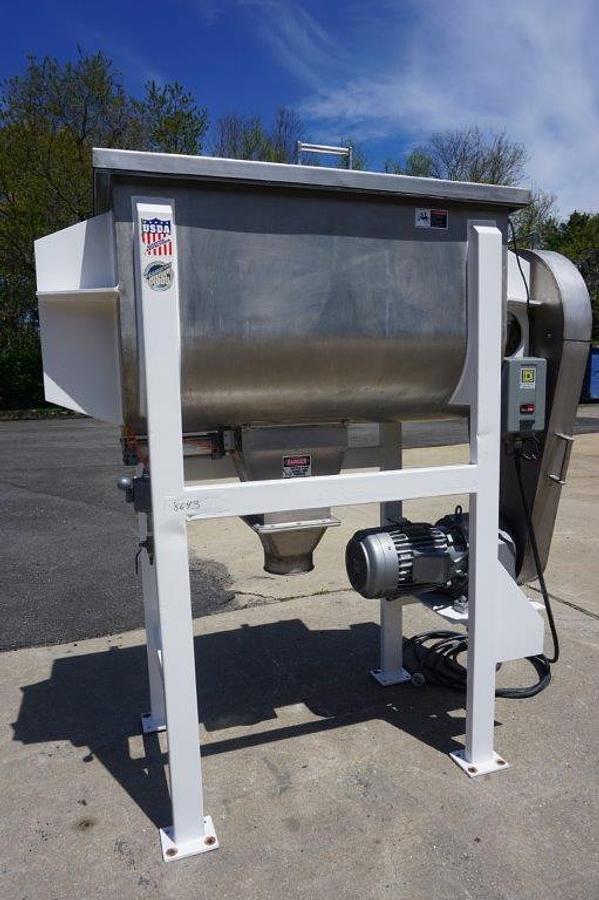
Aim Blending Technologies produces a range of industrial mixing and blending equipment, with a focus on precision blending for demanding production environments. Their lineup typically includes ribbon blenders, paddle mixers, tumble blenders, and high-shear mixers. The double ribbon blender is one of their more recognized configurations, designed to move material in opposing directions simultaneously to achieve a thorough, homogenous mix in a relatively short cycle time. Each equipment type is suited to different blending challenges, from free-flowing dry powders to thicker, more viscous materials.
The ribbon blender design, in particular, has earned a strong reputation in industries where consistent particle distribution matters. The inner and outer ribbon flights create a counterflow action that minimizes dead zones and reduces blending time compared to simpler paddle or tumble configurations. Buyers sourcing used Aim Blending Technologies equipment will commonly encounter stainless steel ribbon blenders in various capacities, which reflects how widely that design was adopted across food processing and pharmaceutical production facilities.
What industries use Aim Blending Technologies mixing equipment?
Aim Blending Technologies equipment is most commonly associated with the food processing and pharmaceutical industries, both of which demand sanitary construction, repeatable blending performance, and materials that can withstand rigorous cleaning protocols. In food production, the equipment is used for blending spice mixes, dry beverage powders, baking ingredients, nutritional supplements, and similar products. In pharmaceutical manufacturing, the same blending precision is applied to active ingredient uniformity in tablet or capsule formulations.
Beyond food and pharma, these mixers also see use in chemical processing, cosmetics manufacturing, and nutraceutical production. Any application that requires homogenous blending of dry or semi-dry ingredients at a production scale is a candidate for this type of equipment. Buyers in these sectors often seek used Aim Blending Technologies machines because the stainless steel construction and sanitary design features hold up well over time, making a well-maintained used unit a practical and cost-effective alternative to purchasing brand-new equipment.
What materials are Aim Blending Technologies mixers constructed from?
Aim Blending Technologies mixing equipment is typically built from stainless steel, which is the standard material choice for industrial blending equipment used in food, pharmaceutical, and chemical applications. Stainless steel offers corrosion resistance, durability, and compatibility with sanitary cleaning requirements such as clean-in-place (CIP) systems or manual washdown procedures. The specific grade of stainless steel, whether 304 or 316L, affects the equipment's suitability for different product types and cleaning agents. Grade 316L, for example, offers greater resistance to chloride-based cleaning chemicals and is often preferred in pharmaceutical environments.
The interior finish of the blending trough is also an important specification. Sanitary applications typically call for a polished interior surface to prevent product buildup and facilitate thorough cleaning between batches. When evaluating used Aim Blending Technologies equipment, buyers should inspect the condition of the stainless steel surfaces, welds, and any seals or gaskets, as these components directly affect sanitary compliance and blending performance. A visual or video inspection prior to purchase can help assess the overall condition of the vessel interior and any wear on the ribbon flights.
What capacity ranges are available for used Aim Blending Technologies ribbon blenders?
Aim Blending Technologies ribbon blenders have been manufactured across a wide range of capacities to suit different production volumes. Smaller units, such as the 10 cubic foot configuration, are well suited to pilot-scale production, specialty batch work, or smaller manufacturing operations where batch sizes are limited. Larger capacity units, ranging into hundreds of cubic feet, are designed for high-volume continuous production environments where throughput is a primary concern. The working capacity of a ribbon blender is typically around 50 to 75 percent of the total vessel volume, which accounts for proper material movement and blending efficiency.
For buyers sourcing used equipment, the available inventory at any given time reflects what has come off production lines and entered the secondary market. A 10 cubic foot unit with a 5 HP motor, for example, represents a compact but capable blending solution for smaller batch applications. Prospective buyers should match the blender capacity to their actual batch requirements, factoring in both minimum and maximum fill levels, since running a large blender at very low fill levels can reduce blending effectiveness and increase cycle times.
Are Aim Blending Technologies mixers suitable for both wet and dry blending applications?
Ribbon blenders and paddle mixers from Aim Blending Technologies are primarily designed for dry and semi-dry blending applications, including powders, granules, and flakes. That said, many configurations can handle light liquid additions, such as spraying a small percentage of oil, flavoring, or binding agent onto a dry product during the blending cycle. This makes them useful for applications like seasoning blends, granola production, or tablet granulation where a small liquid component needs to be evenly distributed across a dry base.
For fully wet or high-viscosity blending applications, a ribbon blender is generally not the ideal choice. High-shear mixers or specialized paddle designs are better suited to emulsification, dispersion of thickeners, or blending of pastes and slurries. When evaluating a used Aim Blending Technologies unit for a specific application, buyers should review the original equipment specifications and consult with a knowledgeable dealer to confirm the machine's design is compatible with their product type, particularly if liquid additions or sticky materials are involved.
How does a ribbon blender achieve homogenous mixing?
A ribbon blender works through a counterflow mixing action created by two sets of helical ribbon flights mounted on a central shaft inside a U-shaped trough. The outer ribbon moves material in one direction along the length of the trough, while the inner ribbon moves material in the opposite direction. This opposing movement continuously folds and recirculates the product, breaking up agglomerates and distributing particles evenly throughout the batch. The result is a consistently blended mixture that would be difficult to achieve with simpler stirring or tumbling mechanisms.
Blend time in a ribbon blender depends on several factors, including the nature of the ingredients, fill level, shaft speed, and the physical properties of the materials being mixed. Dry, free-flowing powders with similar particle sizes and densities typically reach homogeneity faster than blends involving ingredients with significant differences in particle size, density, or moisture content. For used equipment, the condition and alignment of the ribbon flights are worth inspecting, since bent or worn ribbons can create dead zones in the trough and reduce blending efficiency.
What should buyers look for when inspecting used industrial ribbon blenders?
A thorough inspection of a used ribbon blender should cover several key areas. The condition of the stainless steel trough interior is a good starting point, as pitting, deep scratches, or compromised welds can affect sanitary compliance and may indicate the machine was used with abrasive materials or harsh cleaning chemicals. The ribbon flights themselves should be checked for straightness, since bent or deformed ribbons reduce mixing efficiency and can cause uneven wear on the trough. The discharge valve, whether a butterfly valve, slide gate, or flush-bottom design, should operate smoothly without excessive play or leakage.
The drive system, including the motor, gearbox, and shaft seals, deserves careful attention as well. Shaft seals are a common wear item and can be a source of product contamination if they are worn or improperly maintained. Buyers should ask the dealer for any available service records and request an in-person or video inspection to observe the machine's condition firsthand. Dealers who specialize in food and pharmaceutical processing equipment are generally better positioned to assess whether a used blender meets sanitary design standards and can help buyers understand the full scope of any reconditioning that may be needed before the machine goes back into production.
What are the advantages of buying used Aim Blending Technologies mixing equipment versus purchasing new industrial blenders?
The most immediate advantage of purchasing used mixing equipment is cost. A used Aim Blending Technologies ribbon blender or paddle mixer can represent significant savings compared to the price of a comparable unit purchased directly from a manufacturer. For businesses that need to expand capacity quickly, add a redundant blending line, or equip a pilot facility without committing to a large capital expenditure, the used equipment market offers practical options. Lead times are also typically much shorter with used equipment, since the machine is already built and available rather than waiting for a manufacturing queue.
The trade-off is that used equipment is sold as-is, which places the responsibility of due diligence on the buyer. Unlike purchasing from a manufacturer, there is no production warranty or factory support included with a used unit. Buyers should work with reputable dealers who specialize in processing equipment, request detailed inspections, and consult the original manufacturer to understand parts availability and the level of technical support that can be expected for the specific model and age of the machine. Selecting a dealer with a long track record in the food and pharmaceutical equipment sector adds an important layer of credibility to the transaction.
What should buyers understand about shipping and rigging costs for used mixing equipment?
Shipping costs for used industrial mixing equipment vary considerably based on the size and weight of the machine, the distance it needs to travel, and the level of packaging or crating required to protect it in transit. Smaller units, like a 10 cubic foot ribbon blender, may be palletized and shipped via freight carrier with relatively straightforward logistics. Larger blenders with heavy troughs, drive assemblies, and support frames may require custom crating and specialized flatbed or enclosed freight arrangements to prevent damage during transport.
Rigging is another cost that buyers often underestimate. Loading a heavy blender onto a truck at the point of origin and unloading it at the destination facility typically requires a forklift or crane, and in some cases a professional rigging crew. These charges are separate from freight and should be factored into the total landed cost of the equipment before making a purchase decision. Buyers should ask the selling dealer for a detailed breakdown of packaging, rigging, and freight costs upfront so there are no surprises when the machine arrives. For international shipments, customs duties and import fees add another layer of cost that should be researched in advance.
What payment terms are typical when purchasing used industrial mixing equipment?
Most used equipment dealers require full payment prior to releasing a machine for shipment. This is standard practice in the secondary equipment market and reflects the nature of the transaction, where the dealer needs to confirm funds before coordinating logistics and transferring ownership. Payment is commonly accepted by wire transfer, though some dealers may accept other forms depending on the transaction size and their relationship with the buyer. Buyers who are working with a dealer for the first time should expect to pay in full before the machine ships.
For buyers with an established purchasing history with a particular dealer, some level of payment flexibility may be available, though this varies by dealer and is not a standard offering across the industry. Financing through third-party equipment lenders is another option that some buyers explore, particularly for higher-value purchases. Before committing to a purchase, buyers should confirm the exact payment requirements with the dealer, understand the timeline between payment and shipment, and clarify what documentation will be provided upon completion of the sale, including any available records related to the machine's history or condition.