Category
Manufacturer
Model
FAQ:
What is an Accura rotary tablet press and what is it used for?
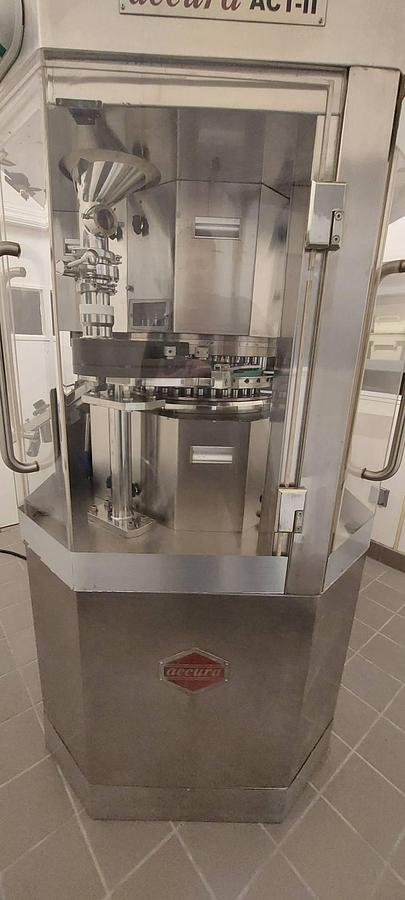
An Accura rotary tablet press is a pharmaceutical-grade machine designed to compress powder or granule formulations into uniform tablets at high speed. Manufactured by Accura, an India-based pharmaceutical machinery company, these presses are used across a range of industries including pharmaceuticals, nutraceuticals, and certain chemical applications. The machines use a rotating turret fitted with multiple punch-and-die stations, where upper and lower punches compress material between them as the turret spins. This continuous rotary action allows for high-volume tablet production compared to single-punch alternatives.
Accura presses are generally positioned as a cost-effective option relative to European brands like Fette or Korsch, which has made them popular among small to mid-size pharmaceutical manufacturers, particularly in developing markets across Asia, Africa, and Latin America. The machines are typically built with stainless steel contact parts (SS316L) to meet hygiene standards and minimize cross-contamination risk, which is a baseline requirement in regulated pharmaceutical production environments. Used Accura rotary tablet presses are available on the secondary market and can represent a practical entry point for manufacturers looking to expand capacity without the capital outlay of purchasing a comparable machine directly from a manufacturer.
How many stations does the Accura ACT II rotary tablet press have, and how does station count affect output?
The Accura ACT II model available on the used equipment market is configured as a 37-station rotary tablet press. Station count refers to the number of punch-and-die sets mounted in the turret, and it has a direct relationship to production output. Each time the turret completes one full rotation, every station produces one tablet, so a 37-station machine produces 37 tablets per revolution. At higher turret speeds, this translates to significantly greater output per hour compared to lower-station-count models.
Across the Accura product line, configurations typically range from around 16 stations up to 45 stations, giving buyers flexibility based on their production scale requirements. A 37-station press like the ACT II sits in the mid-to-upper range of that spectrum, making it well suited for manufacturers with moderate to high volume demands. For context, a 16-station machine running at the same turret RPM would produce roughly half the tablet output per hour. When evaluating a used Accura press, confirming the station count and the condition of the punches and dies is an important part of the inspection process, since tooling wear directly affects tablet weight consistency and surface quality.
What tooling standards are compatible with Accura rotary tablet presses?
Accura rotary tablet presses are generally compatible with TSM (Tablet Specification Manual) and EU (European) tooling standards, which are the two most widely recognized standards in the pharmaceutical tablet compression industry. TSM tooling is the standard most commonly referenced in North American markets, while EU tooling is prevalent in European and many international markets. Both standards define the dimensions and tolerances for punches and dies, and compatibility with one or both gives buyers access to a broader range of tooling suppliers and tablet shape options.
When purchasing a used Accura press, it is worth confirming which tooling standard the specific machine is configured for, since this affects the cost and availability of replacement punches and dies going forward. Tooling is a consumable component in tablet compression and will need to be replaced periodically based on production volume and the abrasiveness of the formulation being compressed. Buyers should also inspect the existing tooling that comes with a used machine, as worn or damaged punches and dies can produce tablets with inconsistent weight, hardness, or surface defects. Consulting with a tooling supplier about compatibility before finalizing a used equipment purchase is a reasonable step in the due diligence process.
What tablet sizes and shapes can an Accura rotary tablet press produce?
The range of tablet sizes and shapes an Accura rotary tablet press can produce is primarily determined by the tooling installed in the machine rather than by the press itself. Standard round tablets in a range of diameters are the most common output, but with appropriate tooling, these machines can also produce oval, capsule-shaped, and other custom geometric forms. The die cavity defines the tablet's footprint and thickness, while the punch tip profile determines the tablet's face shape, including whether it is flat, convex, or embossed with a logo or score line.
For a used Accura press, the tooling that comes with the machine may already be configured for a specific tablet shape and size from its previous production use. Buyers who need a different tablet geometry will need to source compatible tooling separately. Maximum tablet diameter is a spec that varies by model and should be confirmed for the specific machine being evaluated. Generally, mid-range rotary presses in this class handle tablets up to roughly 13mm in diameter for standard configurations, though larger tooling formats are available on some models. Reviewing the machine's technical documentation or consulting with the selling dealer can clarify the exact capacity of a specific used unit.
Are used Accura rotary tablet presses compliant with GMP and FDA regulations?
Accura rotary tablet presses are manufactured to meet Schedule M GMP standards, which is the Indian regulatory framework governing pharmaceutical machinery, and the company markets its equipment as meeting international GMP requirements. Key design features that support GMP compliance include stainless steel contact parts (typically SS316L), enclosed construction to minimize contamination risk, and dust extraction provisions. These characteristics align with the basic mechanical and hygiene requirements that GMP-regulated environments expect from tablet compression equipment.
That said, when buying a used machine, GMP compliance is not simply a function of the original design specifications. The machine's actual condition at the time of purchase matters considerably. A used press that has been well maintained, with intact seals, clean contact surfaces, and properly functioning dust containment, can still meet GMP requirements in a qualified facility. However, a machine that has been poorly maintained or modified may require refurbishment before it can be validated for use in a regulated environment. Buyers operating under FDA oversight or other stringent regulatory frameworks should plan for an equipment qualification process (IQ/OQ/PQ) after installation and should factor the machine's current condition into their evaluation. An in-person or video inspection prior to purchase is a practical way to assess the machine's maintenance history and overall state.
What should buyers inspect before purchasing a used Accura rotary tablet press?
A thorough inspection of a used Accura rotary tablet press should cover both mechanical and compliance-related aspects of the machine. On the mechanical side, key areas include the condition of the turret and punch guides, the state of the upper and lower punch cams, the compression roller assemblies, the feeder mechanism, and the lubrication system. Visible wear on these components can indicate how heavily the machine was used and whether significant reconditioning will be needed. The electrical panel and drive system should also be evaluated, and if possible, the machine should be run under power so the buyer can observe turret rotation, speed control, and any unusual vibration or noise.
Reputable used equipment dealers typically accommodate in-person inspections at their facility or, in cases where the machine is still located at the selling facility, can arrange access for the buyer or a third-party inspector. Video inspections are also commonly offered and can provide a reasonable assessment when travel is not practical. Buyers should ask to see the machine running, even without product, to verify basic mechanical function. Keep in mind that most used equipment dealers are not set up for production testing with actual pharmaceutical formulations, since that requires specialized permitting beyond what a typical dealer holds. Reviewing any available maintenance records, confirming the tooling standard, and checking the condition of contact-part surfaces for corrosion or damage are all steps worth taking before committing to a purchase.
What is the typical production capacity of an Accura rotary tablet press in tablets per hour?
Production capacity for an Accura rotary tablet press depends on two main variables: the number of stations in the turret and the turret speed (measured in RPM). For a 37-station machine like the Accura ACT II, output at moderate operating speeds typically falls in the range of 100,000 to 200,000 tablets per hour, though the actual figure depends on the turret RPM setting used during production and the specific formulation being compressed. Some formulations require slower compression speeds to achieve adequate hardness or to avoid capping and lamination defects, which will reduce effective output.
It is worth noting that published maximum capacity figures represent the mechanical ceiling of the machine under ideal conditions, not necessarily the throughput a buyer should expect in routine production. Factors like formulation flowability, punch tip design, and the need for periodic stops to check tablet weight and hardness all affect real-world output. For a used machine, the condition of the turret drive, compression rollers, and feeding system can also influence the maximum reliable operating speed. When evaluating a used Accura press, asking the dealer about the machine's service history and any known limitations on operating speed can help set realistic production expectations.
How does the cost of a used Accura rotary tablet press compare to other brands on the secondary market?
Accura rotary tablet presses are generally positioned at the more accessible end of the price spectrum for pharmaceutical tablet compression equipment, both on the primary and secondary markets. Compared to used presses from European manufacturers like Fette, Korsch, or Manesty, a used Accura machine of similar station count will typically carry a lower asking price. This price difference reflects the original cost differential between the brands, as well as the broader availability of parts and service support that established European brands tend to offer in certain markets.
For small to mid-size pharmaceutical manufacturers, a used Accura press can represent a practical way to add tablet compression capacity at a fraction of the cost of a comparable European machine. The trade-off to consider is that parts availability and manufacturer support for older Accura models may vary, particularly for buyers located outside of South Asia. Before purchasing, it is advisable to contact Accura directly to understand what level of technical support and spare parts availability can be expected for the specific model and age of the machine being considered. Factoring in the cost of any necessary refurbishment, replacement tooling, and shipping to the final destination will give a more accurate picture of the total landed cost.
What are the typical shipping and logistics considerations when buying a used Accura rotary tablet press?
Rotary tablet presses are substantial pieces of equipment, and shipping logistics require careful planning. A machine like the Accura ACT II needs to be properly secured and protected before transport, which typically means professional palletization or custom crating depending on the distance and mode of transport involved. Heavier machines may also require specialized rigging equipment for loading at the origin and unloading at the destination, and those rigging costs are generally separate from freight charges. Buyers should ask the selling dealer for a detailed breakdown of packaging, rigging, and freight costs to understand the full landed cost before finalizing a purchase.
For international shipments, additional considerations include export documentation, customs clearance, and import duties, all of which vary by destination country. Freight transit times for heavy machinery shipped by ocean freight can range from a few weeks to over a month depending on origin and destination ports. Buyers should also plan for the possibility of delays at customs. Coordinating with the dealer early in the process to confirm packaging standards and get freight quotes from multiple carriers is a reasonable step. Some dealers have established relationships with freight forwarders experienced in moving pharmaceutical machinery, which can simplify the logistics process considerably.
What payment terms should buyers expect when purchasing a used Accura rotary tablet press from a dealer?
Most used equipment dealers require full payment before a machine is released for shipping. This is standard practice in the used machinery industry and applies regardless of the equipment type or value. The reasoning is straightforward: once a machine leaves the dealer's facility, the dealer has limited recourse if payment issues arise. For first-time buyers working with a dealer, full payment upfront is almost always the expectation. Some dealers may extend payment terms to repeat customers with an established purchasing history, but this is the exception rather than the rule.
Buyers should clarify accepted payment methods early in the negotiation process, as dealers may accept wire transfers, letters of credit for international transactions, or other arrangements depending on the transaction size and the buyer's location. It is also worth confirming that the purchase price covers the machine as-is at the dealer's location, and that any additional costs for rigging, crating, freight, and insurance are itemized separately. Getting a clear written quote that breaks out all costs before issuing payment helps avoid surprises and gives both parties a shared understanding of what is included in the transaction.