Category
Manufacturer
Model
FAQ:
What is a ribbon blender and how does it work?
A ribbon blender is a horizontal mixing machine that uses a double helical ribbon agitator mounted on a central shaft inside a U-shaped trough. The outer ribbon moves material inward toward the center of the trough, while the inner ribbon simultaneously moves material outward toward the ends. This counter-directional flow creates a consistent, thorough mix across the entire batch without hot spots or dead zones.
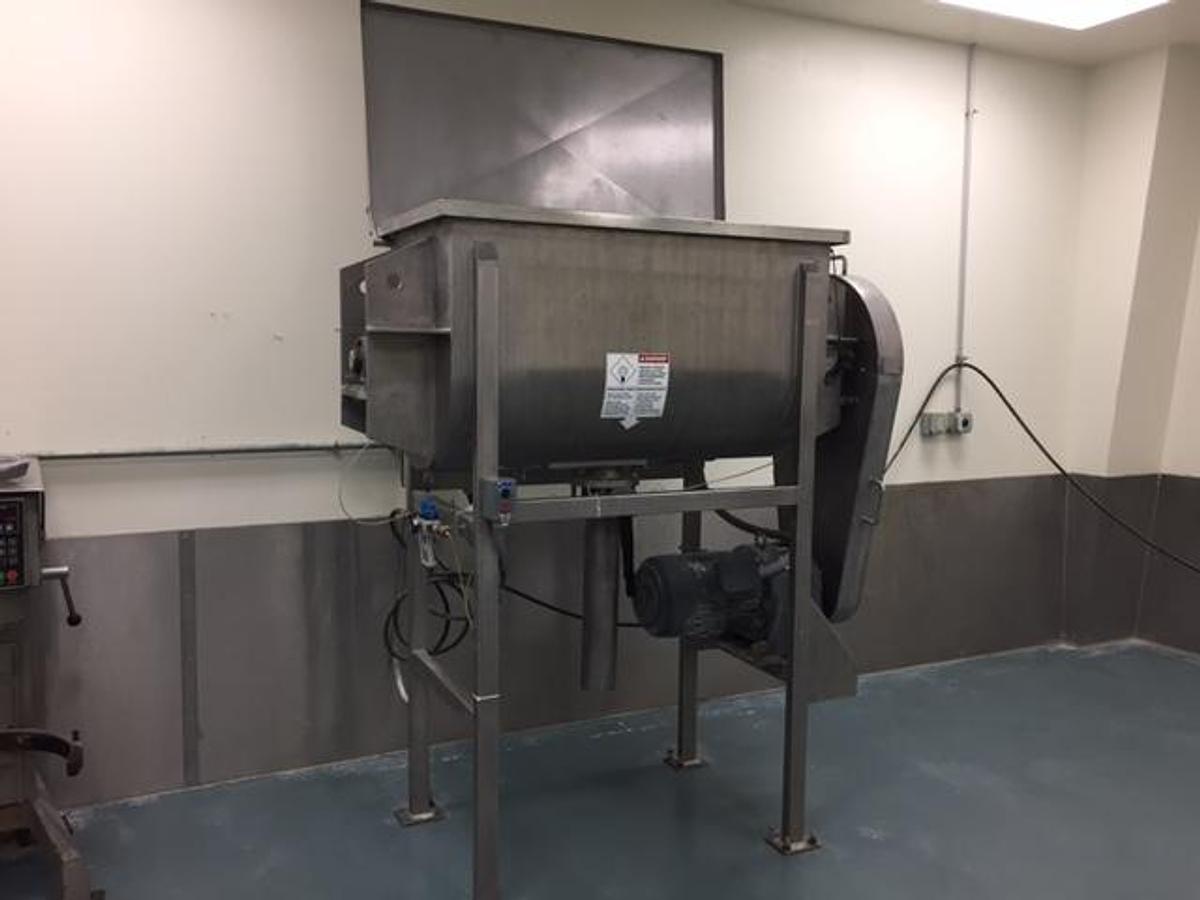
The design is well-suited for blending dry powders, granules, and pastes, and it can also handle light liquid additions when spray nozzles are incorporated. Ribbon blenders are valued for their relatively gentle mixing action, which helps preserve particle integrity, and for their efficiency in achieving homogenous blends in comparatively short cycle times. The center bottom discharge configuration, which is common on units like the 15 cubic foot Aaron stainless steel ribbon blender, allows for fast and complete product evacuation at the end of each batch.
What industries commonly use ribbon blenders?
Ribbon blenders are among the most widely used batch mixing machines across a broad range of processing industries. Food manufacturing is one of the largest application areas, covering dry seasoning blends, baking mixes, protein powders, coffee blends, and animal feed. Pharmaceutical and nutraceutical manufacturers rely on ribbon blenders for blending active ingredients with excipients prior to tablet compression or capsule filling. Chemical processors use them for fertilizers, detergents, pigments, and specialty compounds.
Cosmetics and personal care manufacturers blend powders for foundations, bath salts, and similar products using ribbon blenders. Plastics compounders use them to pre-blend resins, colorants, and additives before extrusion. The versatility of the ribbon blender design means a single machine can often serve multiple product lines within a facility, which makes purchasing a used unit an attractive option for operations looking to expand capacity or add flexibility without a large capital outlay.
What does the stainless steel construction on a ribbon blender mean for buyers?
Stainless steel construction is a critical specification when evaluating a ribbon blender, particularly for food, pharmaceutical, or cosmetic applications. The two most common grades are 304 stainless steel and 316 stainless steel. Type 304 is suitable for most food-grade and general-purpose mixing applications, offering good corrosion resistance and easy cleanability. Type 316 contains added molybdenum, which provides greater resistance to chlorides and harsher chemical environments, making it the preferred choice for pharmaceutical manufacturing and applications involving saline or acidic materials.
For buyers considering a used stainless steel ribbon blender, it is worth inspecting the interior trough, ribbon flights, shaft, and discharge valve for signs of pitting, weld repairs, or surface contamination that could compromise product purity or cleanability. Confirming the actual steel grade through documentation or mill certifications, if available, is advisable before committing to a purchase, especially for regulated industries. A unit like a 15 cubic foot stainless steel ribbon blender with center bottom discharge is a practical size for pilot-scale production or smaller batch operations in these sectors.
What sizes and capacities are available for used ribbon blenders?
Used ribbon blenders are available across a wide range of capacities, from small laboratory-scale units of around 1 cubic foot up to large industrial machines exceeding 200 cubic feet. Mid-range units in the 10 to 50 cubic foot range are among the most commonly traded on the used equipment market because they fit well into contract manufacturing, mid-volume production, and pilot operations. A 15 cubic foot unit, for example, can process batches ranging from roughly 400 to over 1,000 pounds depending on the bulk density of the material being blended.
When selecting a capacity, buyers should account for the working fill level of the blender, which is typically 40 to 70 percent of the rated volume for optimal mixing efficiency. Running a ribbon blender significantly underfilled or overfilled reduces blending effectiveness and can accelerate wear on the agitator and drive components. Purchasing a used blender in a size that matches current production volumes, with some headroom for growth, is generally a more cost-effective approach than buying oversized equipment that will run at a fraction of its capacity.
Is a used ribbon blender suitable for food-grade applications?
A used ribbon blender can absolutely be suitable for food-grade applications, but suitability depends on the construction materials, the machine's history, and its current physical condition. Stainless steel construction, sanitary welds, a center bottom discharge valve, and an easily cleanable interior are the baseline requirements for food processing use. Buyers should ask about the previous product history of the machine, since a blender used for chemicals or pigments may have residual contamination concerns that make food-grade use impractical regardless of how thoroughly it is cleaned.
For food and pharmaceutical buyers, it is worth requesting detailed photos of the interior trough, the ribbon agitator, the shaft seals, and the discharge assembly. Worn or damaged seals can harbor bacteria or allow product contamination. Some facilities will require third-party inspection or internal cleaning and re-certification before placing a used machine into a regulated production line. Working with a reputable used equipment dealer who can provide thorough documentation and accommodate in-person or video inspections significantly reduces the risk involved in purchasing a used ribbon blender for food-grade production.
What should buyers inspect when evaluating a used ribbon blender?
Evaluating a used ribbon blender requires a systematic look at several key components. The ribbon flights themselves are the first place to check, as the helical blades can wear down, crack, or pull away from the central shaft over years of operation. Worn ribbons reduce mixing efficiency and can indicate the machine has had a hard service life. The shaft seals and end-plate seals should be inspected for wear or leakage, as failing seals allow product to escape and can introduce contamination. The drive components, including the motor, gearbox, and any belt or chain drives, should be examined for signs of overheating, oil leaks, or excessive wear.
The discharge valve is another critical point. Center bottom discharge valves on ribbon blenders take repeated mechanical stress and exposure to product, so checking for tight closure, smooth operation, and absence of leakage is important. Buyers should also look at the trough interior for corrosion, pitting, weld repairs, or residue buildup. Most reputable used equipment dealers will accommodate in-person inspections at their facility or at the plant where the equipment is currently located. Video inspections are also commonly offered, and requesting a detailed video walkthrough of the machine in its current state is a practical option for buyers who cannot travel.
What is the typical price range for a used ribbon blender?
Pricing for used ribbon blenders varies considerably based on capacity, construction material, condition, and age. Small units under 5 cubic feet in carbon steel can sometimes be found for a few thousand dollars, while mid-range stainless steel units in the 10 to 50 cubic foot range typically trade between roughly $5,000 and $30,000 depending on condition and specifications. Larger industrial units above 100 cubic feet in stainless steel can command significantly higher prices. Stainless steel construction adds meaningful cost over carbon steel at any given capacity, reflecting both material value and the broader range of applications it supports.
Buyers should factor in costs beyond the listed price when budgeting for a used ribbon blender. Rigging, crating, freight, and any refurbishment work needed after arrival can add substantially to the total landed cost. Asking the dealer for a clear breakdown of packaging requirements, rigging costs for loading, and estimated freight to the destination gives a more accurate picture of the full investment. In many cases, a well-maintained used stainless steel ribbon blender purchased at the right price represents significant savings compared to purchasing a comparable machine through other channels.
How does the center bottom discharge design affect ribbon blender performance?
The center bottom discharge configuration is one of the most practical design features on a ribbon blender intended for batch production. Placing the discharge valve at the lowest point of the trough, centered along the length of the machine, allows gravity to assist product evacuation. When the discharge valve opens at the end of a blend cycle, the ribbon agitator can continue to rotate and sweep remaining product toward the opening, resulting in fast and nearly complete discharge with minimal residual material left in the trough.
This matters for several reasons. In food and pharmaceutical production, complete discharge reduces cross-contamination risk between batches and simplifies cleaning. In any production environment, it reduces product loss and improves yield per batch. The alternative, end discharge designs, can leave more material behind and take longer to empty fully. For buyers evaluating a used ribbon blender, confirming the discharge valve operates smoothly, seals completely when closed, and shows no signs of wear or leakage is an important part of the inspection process, since the discharge assembly is one of the higher-wear components on the machine.
What should buyers understand about purchasing used ribbon blenders without a warranty?
Used industrial equipment is typically sold on an as-is basis, which means the buyer assumes responsibility for assessing the machine's condition before completing the purchase. Unlike buying directly from a manufacturer, there is no standard warranty coverage on used machinery. This makes the pre-purchase inspection process especially important. Buyers who skip thorough due diligence take on greater risk of discovering mechanical issues after the machine has shipped and been installed.
The most effective way to manage this risk is to work with used equipment dealers who have a long track record in the industry and who specialize in processing equipment. Reputable dealers will typically accommodate in-person inspections at their warehouse, or at the plant where the equipment is currently located if it has not yet been removed from service. Video inspections and detailed photo documentation are also commonly available. It is also worth contacting the original equipment manufacturer directly to understand what level of technical support, spare parts availability, and service documentation can be expected for the specific model and approximate age of the machine being considered, since this varies by manufacturer and production era.
What are the typical shipping and logistics considerations when buying a used ribbon blender?
Shipping a used ribbon blender involves more logistical planning than most standard freight shipments. The machine must be properly secured and protected before transit, and the level of packaging required depends on the size and weight of the unit. Smaller blenders may ship palletized with appropriate blocking and bracing, while larger units typically require custom wooden crating to prevent damage in transit. Buyers should ask the dealer specifically what packaging will be provided and whether crating costs are included in the listed price or billed separately.
For heavier units, rigging is required both for loading at the dealer's facility and for unloading at the buyer's location. Rigging costs can be significant for large industrial blenders and should be factored into the total landed cost calculation. Buyers are responsible for having appropriate unloading equipment available on their end, whether that is a forklift, overhead crane, or a contracted rigging crew. Freight charges will vary based on distance, carrier, and the freight class of the equipment. Getting a full cost breakdown from the dealer before finalizing a purchase, covering packaging, rigging, and estimated freight, is the best way to avoid surprises and accurately compare the total cost against other options.