





Wine Processing and Packaging Equipment
Tanks, Filters, Fillers, Bottling Equipment, and More
Wohl Associates offers a wide selection of pre-owned wine processing and packaging equipment for wineries of every size. Our inventory includes tanks, fermenters, agitators, centrifuges, filter presses, and filters used throughout fermentation, aging, and clarification, along with CIP and cleaning systems to keep your cellar running smoothly. For bottling lines, we stock liquid fillers, cappers, labelers, coders, case packers, conveyors, and unscramblers to complete your process from tank to bottle. Browse our dedicated wine equipment category for specialized machinery built specifically for the wine industry.
Frequently Asked Questions
What types of equipment are involved in wine processing and packaging?
Wine production covers a broad range of equipment categories, each tied to a specific stage of the process. On the processing side, this includes fermentation tanks, agitators, centrifuges, filter presses, and various filtration systems used during fermentation, aging, and clarification. Pumps move wine between vessels, while CIP (Clean-In-Place) and general cleaning and rinsing systems keep the cellar sanitary between batches. Chillers and freezers also play a role in temperature-controlled fermentation and cold stabilization.
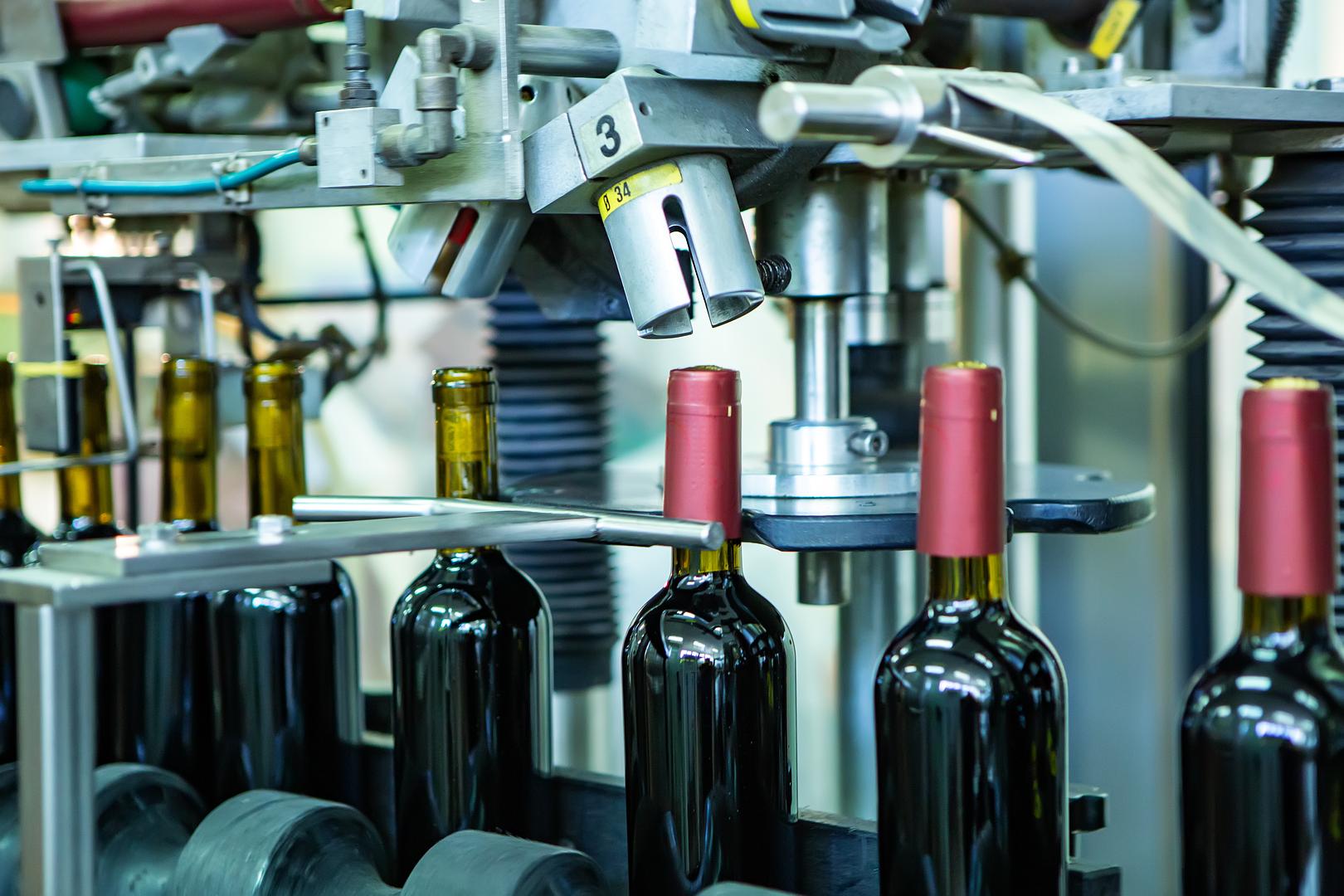
On the packaging side, a complete bottling operation typically requires liquid fillers, cappers, corkers, labelers, coders, unscramblers or rotary tables, conveyors, and case packers or sealers. Some mid-size wineries opt for monoblock systems that combine filling, corking, and capping into a single machine, which saves floor space and reduces the number of operators needed. Understanding which stage of production you are equipping is the first step in identifying the right machines, since a winery building out a full line from tank to finished case will have very different needs than one looking to add a single piece of equipment to an existing setup.
What equipment does a winery need to set up a complete bottling line from scratch?
A complete wine bottling line starts before the bottle is even filled. Unscramblers or rotary accumulation tables orient and feed bottles into the line at a controlled pace. From there, a liquid filler meters the correct volume of wine into each bottle, followed by a corker or capper depending on the closure type. Capsuling equipment applies foil or shrink capsules over the closure, and labelers apply front, back, and neck labels. Coders or date-stamp printers mark bottles with lot codes or best-by dates for traceability. Conveyors link each station, and at the end of the line, case packers or sealers bundle finished bottles into shipping cases.
Before any of this happens, the wine itself needs to be properly clarified and stable, which means filtration equipment, such as filter presses, depth filters, or membrane filters, should be in place upstream of the filler. Pumps are needed throughout to move product between tanks and into the filler hopper. For wineries sourcing used equipment, it is worth mapping out the full production flow before purchasing individual machines, since compatibility between line speeds, bottle formats, and closure types all affect how well the components work together. Buying from a dealer that specializes in wine and beverage equipment makes it easier to find machines that are already configured for wine-industry applications.
What should small or boutique wineries look for when buying used wine processing equipment?
Small and boutique wineries typically produce in the range of a few hundred to a few thousand cases per year, which means they need equipment scaled to lower throughput rather than high-speed commercial lines. For bottling, semi-automatic fillers and tabletop or floor-standing corkers are common choices at this scale, since they offer reasonable output without the complexity and footprint of a fully automatic monoblock system. On the processing side, smaller fermentation tanks, compact filter presses, and portable pumps are well-suited to limited cellar space and variable batch sizes.
For boutique operations buying used equipment, condition and mechanical simplicity matter more than they might for a large commercial winery with an in-house maintenance team. Simpler machines with fewer electronic components tend to be easier to service and have more readily available replacement parts. It is worth asking the seller about the machine's production history, the last time it was serviced, and whether the original manufacturer still supports that model with parts and technical guidance. Requesting a video inspection or, where possible, an in-person visit to see the machine before purchase gives smaller buyers the clearest picture of what they are getting, since used equipment is sold as-is and the buyer carries the responsibility of evaluating condition.
What is the difference between manual, semi-automatic, and fully automatic wine bottling equipment?
Manual bottling equipment requires an operator to handle most of the physical steps, such as placing bottles, triggering fills, and inserting corks or caps individually. This category includes hand-operated corkers, gravity fillers with manual valves, and handheld labelers. Output is slow, typically measured in dozens of bottles per hour, and labor costs per bottle are high. Manual equipment is best suited to very small estate wineries or home winemakers who bottle infrequently and in small quantities.
Semi-automatic machines automate one or more steps while still requiring an operator to load, position, or transfer bottles between stations. A semi-automatic filler, for example, might open and close valves automatically once a bottle is placed by hand, while a semi-automatic labeler applies labels at the press of a foot pedal. Fully automatic systems handle the entire sequence, from bottle feeding through filling, corking, capsuling, labeling, and case packing, with minimal human intervention beyond loading bulk supplies and monitoring the line. Throughput on fully automatic lines can range from several hundred to several thousand bottles per hour depending on the machine. For most growing wineries, the decision between semi-automatic and fully automatic comes down to production volume, available labor, and floor space, since fully automatic lines require more room, more maintenance expertise, and a higher upfront investment even when purchased as used equipment.
How do I choose the right wine filtration system for my production volume?
Filtration needs in a winery vary significantly by production scale and the style of wine being made. At the smallest scale, plate-and-frame filter presses using cellulose or diatomaceous earth pads are common because they are relatively affordable, easy to operate, and effective at removing yeast, bacteria, and sediment before bottling. For higher-volume operations, pressure leaf filters and cross-flow membrane filtration systems offer faster throughput and more consistent results, though they require more capital and technical knowledge to operate correctly.
When selecting a filtration system, production volume is the primary driver. A filter rated for 500 gallons per hour will create a bottleneck in a winery producing 5,000 gallons per day. Micron rating is another key consideration, since coarse filtration removes large particles while sterile filtration (typically 0.45 micron) removes microorganisms and is often required before bottling wines that are not chemically stable. Buyers sourcing used filtration equipment should verify the filter's material construction (stainless steel 304 or 316 is the industry standard for food-grade, corrosion-resistant applications), inspect seals and filter media housings for wear, and confirm that replacement filter pads, cartridges, or membranes are still available for that specific model. A reputable used equipment dealer specializing in wine and beverage machinery can help identify which filtration equipment has a strong aftermarket support history.
What is the typical bottles-per-hour output for different types of wine bottling machines?
Output capacity varies widely across the spectrum of bottling equipment. At the low end, manual or entry-level semi-automatic fillers typically handle anywhere from 100 to 400 bottles per hour, depending on the number of filling heads and the operator's pace. Mid-range semi-automatic and entry-level automatic systems generally fall in the 400 to 1,500 bottles-per-hour range, which is appropriate for small commercial wineries producing up to around 10,000 cases per year. High-speed fully automatic monoblock lines designed for large-scale production can exceed 3,000 to 6,000 bottles per hour or more.
It is important to look at the entire line's throughput rather than just one machine's rated capacity, since the slowest piece of equipment determines the actual output. A high-speed filler paired with a slow labeler will not achieve its rated speed in practice. When evaluating used bottling equipment, ask for the machine's original rated capacity and, where possible, request documentation or a video showing the machine running at or near that speed. Keep in mind that actual throughput in a production environment can differ from nameplate specs depending on the bottle format, closure type, wine viscosity, and the skill of the operators running the line.
Are used wine processing and packaging machines compatible with different bottle sizes and formats?
Many wine processing and packaging machines are designed with adjustability in mind, since wineries commonly run multiple bottle formats across their product lines. Fillers, labelers, cappers, and corkers often include adjustable guides, changeover parts, or format kits that allow the machine to handle standard 750ml Bordeaux and Burgundy bottles as well as 375ml half-bottles, 1.5L magnums, and sometimes even non-standard shapes like Alsatian or Champagne-style bottles. The degree of adjustability varies significantly by manufacturer, model, and age of the machine.
For buyers sourcing used equipment, it is critical to ask specifically which bottle formats the machine is currently set up for and whether changeover parts for other sizes are included with the sale. Format parts are sometimes lost or sold separately over a machine's working life, and sourcing them after the fact can be time-consuming and costly. Closure compatibility is equally important: a corker designed for natural cork may not handle synthetic closures or screw caps without modification, and vice versa. Inspecting the machine in person or via video before purchase is the most reliable way to confirm what format tooling is present and in what condition, since used equipment is sold as-is and the buyer is responsible for verifying suitability for their specific production needs.
What materials should wine processing equipment be made from, and why does it matter?
Stainless steel is the dominant construction material for wine processing and packaging equipment, and for good reason. Grade 304 stainless steel is the most common specification for tanks, fermenters, pumps, fillers, and filter housings because it resists corrosion from the acids, sulfites, and cleaning chemicals used throughout wine production. Grade 316 stainless steel offers even greater resistance to chloride-based cleaners and is often specified for equipment that sees more aggressive sanitation protocols or extended contact with acidic wine. Both grades are non-porous, which limits microbial harboring and makes surfaces easier to clean and sanitize between batches.
For components that contact wine directly, food-grade materials extend beyond the metal structure itself. Gaskets, seals, tubing, and valve seats should be made from food-safe elastomers such as silicone or EPDM rather than standard rubber or PVC compounds that can leach off-flavors into the wine. When evaluating used wine equipment, checking the condition of these softer components is just as important as inspecting the metal body, since seals and gaskets degrade over time and may need replacement before the machine is put back into production. A seller who specializes in wine and beverage equipment will typically be able to advise on the material specifications of the machines they carry and help buyers identify what refurbishment may be needed.
How is CIP (Clean-In-Place) capability used in wine production, and which equipment typically includes it?
Clean-In-Place (CIP) refers to a system that circulates cleaning and sanitizing solutions through equipment without requiring full disassembly between uses. In a winery, CIP capability is most commonly found on fermentation tanks, storage tanks, and transfer lines, where it allows operators to flush, clean, and sanitize vessels using hot water, caustic solutions, and acid rinses in a defined sequence. This reduces downtime between batches, lowers labor requirements, and minimizes the risk of microbial contamination that can compromise wine quality. Larger wineries running continuous or back-to-back production schedules benefit the most from CIP-capable equipment.
On the packaging side, CIP circuits are found on some liquid fillers and piping systems where wine contacts internal surfaces that are difficult to reach manually. Standalone CIP skids, which include tanks, pumps, heat exchangers, and controls to generate and deliver the cleaning solutions, are also available as separate pieces of equipment that can be integrated into an existing cellar. For buyers sourcing used CIP systems or CIP-capable tanks and fillers, it is worth verifying that all spray balls, nozzles, and internal piping are intact and unobstructed, since these components are critical to achieving effective coverage. A video inspection showing the CIP system running, or at minimum showing the internal condition of tanks and spray assemblies, gives buyers a reasonable basis for assessing whether the system will perform as expected.
What should buyers expect regarding inspections and payment when purchasing used wine equipment?
Used wine and beverage equipment is typically sold as-is, which places the responsibility of evaluating condition squarely on the buyer. Reputable dealers will accommodate inspections in person, by video call, or through detailed video recordings of the machine. In some cases, equipment may still be installed at the original production facility where it was used, and an in-person inspection can be arranged between the buyer, the dealer, and the facility owner. Buyers should keep in mind that most equipment dealers do not have production-grade facilities for running actual wine through a machine, so testing is generally limited to mechanical operation rather than a full production run.
On payment, most used equipment dealers require full payment before the machine ships. Some dealers extend payment terms to established repeat customers, but this is not a standard practice across the industry. Buyers should also factor in the full landed cost of the equipment beyond the purchase price, since shipping charges, crating or palletization fees, and rigging costs for loading and unloading heavy machinery can add meaningfully to the total. Larger tanks, presses, and multi-component bottling lines often require specialized rigging equipment for safe loading and transport. Asking the dealer for a complete breakdown of packaging, freight, and rigging costs before finalizing a purchase helps avoid surprises and makes it easier to compare the true cost of different machines.
Explore Our Full Equipment Inventory
Browse thousands of listings across every category we support or reach our team directly for help finding the right machine for your operation.