





Condiments Sauces and Peanut Butter Processing Equipment
Mixers, Kettles, Fillers, Packaging Machines, and More
We supply pre-owned processing and packaging equipment for condiment, sauce, dressing, and peanut butter manufacturers. Our inventory includes kettles, agitators, double-arm and sigma mixers, colloid mills, and homogenizers for cooking, blending, and emulsifying, along with heat exchangers, liquefiers, tanks, and pumps for handling and heat treatment. CIP and cleaning systems help keep your process sanitary between batches. For packaging, we stock cup fillers, liquid fillers, form/fill/seal machines, positive displacement fillers, cappers, canning equipment, labelers, coders, and metal detectors to complete your line.
Condiments and Sauces Equipment Categories
Frequently Asked Questions
What types of equipment are used in commercial peanut butter and condiment sauce production?
A complete peanut butter or condiment sauce production line typically involves several distinct equipment categories working in sequence. On the processing side, colloid mills and homogenizers handle the grinding and emulsification stages, while kettles, agitators, and double-arm or sigma mixers are used for cooking, blending, and incorporating ingredients. Heat exchangers manage temperature during processing, and liquefiers help handle viscous materials. Tanks and pumps move product between stages, and CIP (clean-in-place) systems keep the line sanitary between batches.
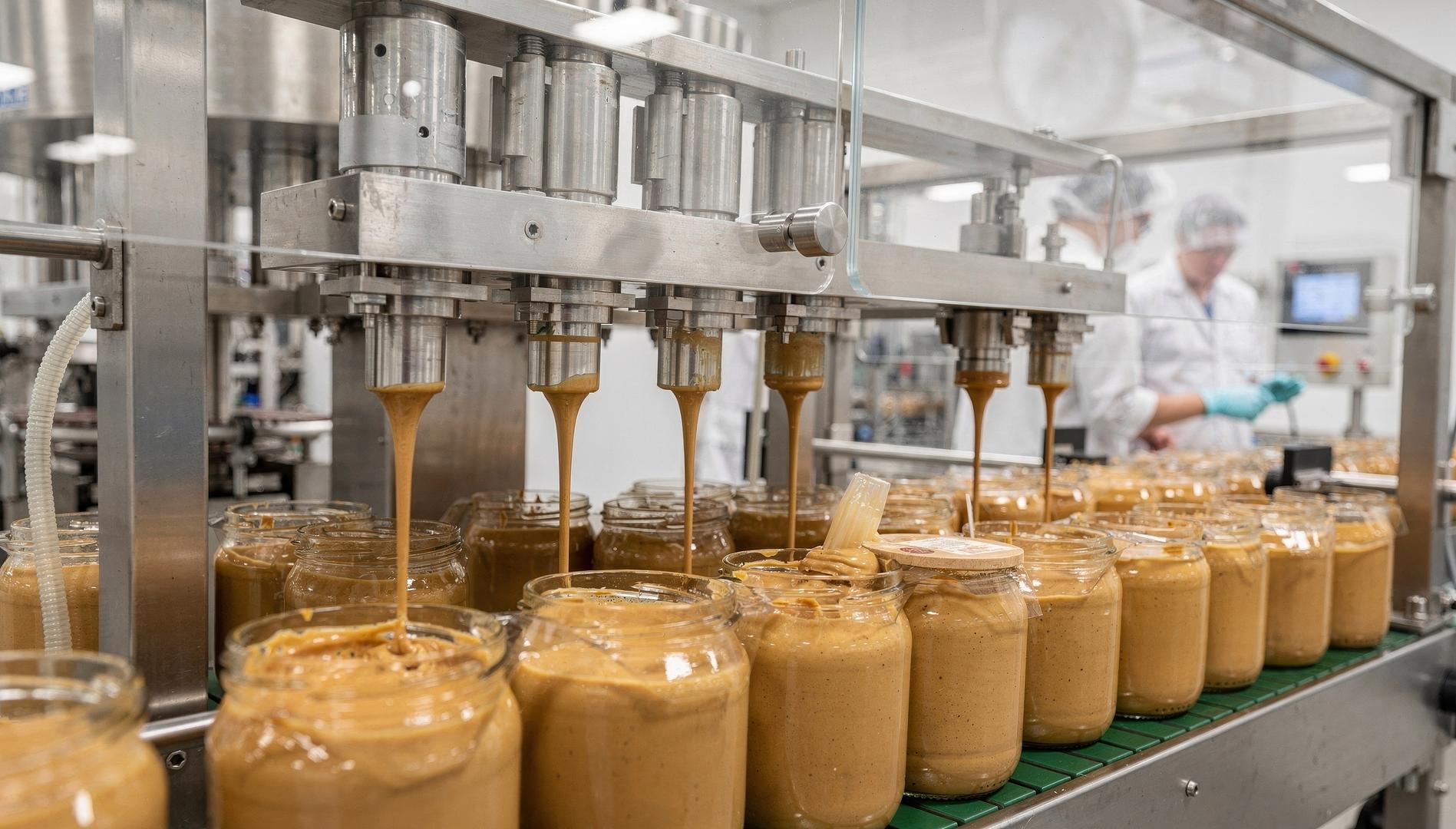
Once the product is ready, packaging equipment takes over. This typically includes cup fillers, liquid fillers, positive displacement or piston fillers (which are especially well-suited for thick, viscous products like peanut butter), form/fill/seal machines, cappers, labelers, coders, and metal detectors. The exact combination of machines depends on production volume, product viscosity, container type, and line speed. A small artisan operation might run a single colloid mill feeding a semi-automatic filler, while a large-scale manufacturer could have a fully integrated line running hundreds of units per minute.
What is the difference between a colloid mill and a stone grinder for peanut butter production?
Colloid mills and stone grinders both reduce roasted peanuts into a paste, but they produce noticeably different results and suit different production contexts. A colloid mill uses a high-speed rotor-stator mechanism with an adjustable gap, which allows operators to dial in particle size with precision. The result is a very fine, uniform, commercially smooth peanut butter. Colloid mills also handle high throughput efficiently, making them the standard choice for mid-to-large scale commercial production. They can typically process other nut butters, hummus, chili paste, and similar condiment bases as well, which adds versatility to the investment.
Stone grinders, by contrast, use granite or other abrasive stone wheels to slowly crush peanuts into paste. The process generates less heat, which is a meaningful advantage since excessive heat during grinding degrades oils, shortens shelf life, and can destroy heat-sensitive nutrients. Stone grinders tend to produce a coarser, more textured paste that is popular with artisan and natural peanut butter brands. They are generally lower throughput machines. For buyers evaluating used equipment, understanding which texture and production volume their operation requires is the most important first step in selecting the right grinding technology.
Can peanut butter processing equipment also handle other nut butters and condiment pastes?
Most commercial grinding and mixing equipment designed for peanut butter is quite adaptable, and many machines handle a wide range of similar products without significant modification. Colloid mills, for example, are regularly used for almond butter, cashew butter, sunflower seed butter, tahini, and even non-nut products like hummus, chili paste, and certain condiment sauces. The key variable is the gap adjustment on the mill, which controls particle size and can be tuned to match the characteristics of different raw materials. Agitators, kettles, and mixing equipment used for condiment sauces are similarly flexible, handling everything from thin vinaigrettes to thick barbecue sauces or relishes.
Buyers sourcing used equipment for a multi-product operation should pay close attention to the construction materials of contact parts, as allergen cross-contamination is a serious concern. Food-grade stainless steel (typically 304 or 316 grade) is the standard for equipment that will be used across different nut-based products. CIP systems and easy-disassembly designs make cleaning between product runs more practical. When evaluating a specific used machine, asking the seller about its production history and what products it previously ran can give useful context about its real-world versatility.
What construction materials should food processing equipment for sauces and peanut butter be made from?
For any equipment that comes into direct contact with food product, food-grade stainless steel is the standard material of choice. Grade 304 stainless steel is the most common in food processing applications and offers good corrosion resistance for most sauce, condiment, and nut butter environments. Grade 316 stainless steel provides additional resistance to chlorides and acidic ingredients, making it preferable for equipment handling products with higher vinegar or salt content, such as hot sauces, pickles, or certain dressings. Both grades are non-porous, easy to clean, and compatible with standard food-grade sanitizing chemicals.
Beyond the base material, buyers should also look at seals, gaskets, and any plastic components that contact the product. These should be made from FDA-compliant materials such as UHMW polyethylene, Teflon, or food-grade silicone. When evaluating used equipment, it is worth inspecting contact surfaces carefully for pitting, cracks, or worn seals that could harbor bacteria or compromise sanitation. Reputable used equipment dealers will typically accommodate in-person or video inspections so buyers can assess the condition of these surfaces before committing to a purchase.
How does temperature control during peanut butter grinding affect product quality?
Heat management is one of the more underappreciated factors in peanut butter production, and it has a direct impact on flavor, oil stability, and shelf life. During high-speed grinding in a colloid mill or similar machine, friction generates significant heat. If the product temperature rises too high, the natural oils in the peanuts begin to degrade, which accelerates rancidity and shortens shelf life. Excessive heat can also destroy heat-sensitive nutrients and alter the flavor profile in ways that are difficult to reverse once the damage is done.
Many commercial colloid mills and grinding machines include water-jacketed housings or other cooling mechanisms specifically to manage this issue. When evaluating used equipment, buyers should confirm whether the machine includes cooling features and whether those systems are still functional. For operations producing natural or minimally processed peanut butter where ingredient integrity is a selling point, temperature control during grinding is especially worth scrutinizing. Stone grinders are often favored in artisan settings partly because their slower processing speed generates less frictional heat, though they sacrifice throughput in exchange for that advantage.
What production capacity tiers exist for peanut butter and sauce processing equipment, and how do I choose the right one?
Processing equipment for peanut butter and condiment sauces generally falls into a few broad capacity ranges. Smaller machines typically handle 50 to 200 kilograms per hour and are suited to artisan producers, food startups, or operations running multiple small-batch SKUs. Mid-range equipment runs roughly 200 to 500 kilograms per hour and fits growing regional brands or contract manufacturers handling moderate volume. Large industrial machines process 500 kilograms per hour and above, designed for high-volume commercial facilities running extended production shifts.
Choosing the right capacity tier requires honest assessment of current production volume, realistic growth projections, and the number of production hours available per day. Undersizing equipment leads to bottlenecks and overtime; oversizing means paying for capacity that sits idle and may be harder to clean and maintain efficiently at low utilization. For buyers sourcing used equipment, capacity ratings on older machines should be verified against actual operating conditions, since wear over time can affect throughput. Asking the seller about the machine's production history and whether it was running at or below rated capacity gives a more accurate picture than spec sheets alone.
What is a positive displacement filler, and why is it commonly used for peanut butter and thick condiments?
A positive displacement filler, sometimes called a piston filler, moves a precise, fixed volume of product per fill cycle by drawing product into a cylinder and then pushing it into the container with a piston. Because the fill volume is mechanically controlled rather than dependent on flow rate or gravity, this type of filler handles thick, viscous, or particulate-laden products accurately and consistently. Peanut butter, thick barbecue sauce, salsa, hummus, and similar products are notoriously difficult to fill with gravity or overflow fillers, and positive displacement designs were developed largely to address that challenge.
For used equipment buyers, positive displacement fillers are among the more durable and long-lived machines in a packaging line, partly because their mechanical simplicity means fewer failure points. Key things to evaluate on a used piston filler include the condition of the cylinder seals, the smoothness of the piston action, and whether the product contact parts are intact and free of scoring or corrosion. The number of fill heads and the adjustable volume range are also important specs to confirm against actual production container sizes. Many used fillers can be reconfigured for different container formats, which adds flexibility for operations running multiple product lines.
What role do CIP systems play in condiment and sauce production, and what should buyers look for in used CIP equipment?
CIP stands for clean-in-place, and it refers to automated or semi-automated systems that circulate cleaning solutions, rinse water, and sanitizing agents through processing equipment without requiring full disassembly. In condiment and sauce production, where product changeovers, allergen control, and microbial sanitation are ongoing concerns, CIP systems significantly reduce downtime between batches and improve cleaning consistency compared to manual methods. They are especially valuable in facilities producing multiple products on shared equipment, such as a line that runs both peanut butter and a nut-free condiment.
When evaluating used CIP equipment, buyers should assess the condition of pumps, spray nozzles, valves, and control systems, since these components see heavy use and chemical exposure over time. The compatibility of the CIP system with the rest of the processing line is also important, including flow rates, connection fittings, and the types of cleaning chemicals the system is designed to handle. A dealer who specializes in food processing equipment will typically be able to provide inspection access, either in person or via video, so buyers can assess the system's current condition before purchase. Consulting the original manufacturer about parts availability for older CIP units is also a prudent step.
What should buyers know about inspecting used peanut butter and sauce processing equipment before purchase?
Buying used processing equipment requires more diligence than sourcing from an original manufacturer, because the machine's history, wear patterns, and current condition are not always immediately obvious from photos or spec sheets. Reputable used equipment dealers will typically offer in-person inspections, video walkthroughs, or recorded video captures of the machine so buyers can evaluate its condition directly. Some equipment may still be installed and running at the facility where it was originally used, which provides an opportunity to see it in operation. In other cases, the machine may have been decommissioned and moved to a dealer's warehouse.
Buyers should focus their inspection on food-contact surfaces (looking for pitting, cracks, or worn seals), drive components and motors, control systems, and any hydraulic or pneumatic elements. One important limitation to keep in mind is that most used equipment dealers do not have production-licensed facilities, so they cannot run actual food product through a machine during an inspection. The inspection is about mechanical function and physical condition, not a full production trial. For complex or high-value machines, some buyers hire independent machinery inspectors or process engineers to conduct a technical evaluation. Consulting the original manufacturer about the specific model's service history, parts availability, and known wear points is also a smart step before finalizing a purchase.
What are the typical shipping and payment considerations when buying used food processing equipment?
Used processing equipment for condiment and sauce production ranges from compact tabletop colloid mills to large multi-ton kettle systems, and the logistics of getting a machine from a seller to a buyer's facility vary considerably based on size and weight. Smaller machines may ship on a standard pallet with appropriate blocking and bracing. Larger equipment typically requires custom crating, and very heavy or oversized machines need professional rigging for loading and unloading, which adds cost beyond the base freight rate. Buyers should ask sellers for a detailed breakdown of packaging, rigging, and freight costs early in the process to understand the full landed cost of the equipment, not just the purchase price.
On the payment side, most used equipment dealers require full payment prior to shipping. Some dealers extend payment terms to repeat customers or established buyers, but this is not the norm for first-time transactions. Because used equipment is generally sold as-is without the protections that come with factory-direct purchases, buyers benefit from working with dealers who have a long track record in the food processing equipment space and who specialize in the relevant industry. That combination of experience and specialization is one of the more reliable indicators that a dealer understands the equipment they are selling and can accurately represent its condition.
Explore Our Full Equipment Inventory
Browse thousands of listings across every category we support or reach our team directly for help finding the right machine for your operation.